A Letter to the Church I Love, Serve, and the Church I Hope For.
By Charity Tozivepi-Nzegwu
17 October 2025
17 October 2025
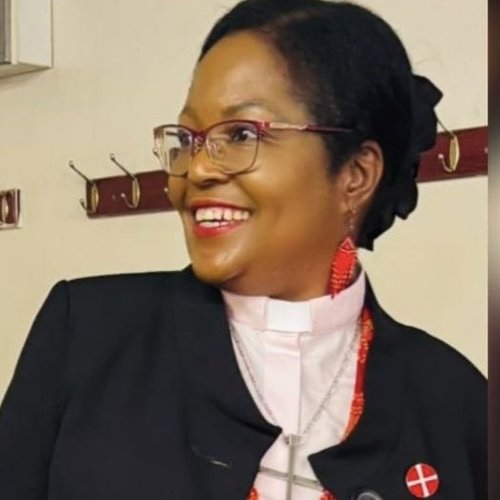
Charity Tozivepi-Nzegwu is a presbyter in the Cambridge Circuit and Chair of the Connexional Justice, Dignity and Solidarity Committee. She shares this letter to the Church on the importance of Black History Month and her journey to becoming a black, leader in the Methodist Church.
My Beloved Friends,
Grace and peace to you in the name of Christ, who breaks down every dividing wall.
I am grateful to have received this invitation to contribute to the Black History Month celebrations. To be asked to share as a Black African woman serving in “senior” leadership within the Methodist Church in Britain is both a privilege and a weight. I do this work because I have a conviction that my presence in these spaces is not accidental but the fruit of a God who calls, equips, and insists that all God’s children, irrespective of race, ethnicity, gender, social status, immigration status, age, ability, sexual orientation or history, have a place at the table of leadership.
Black History Month is not nostalgia. It is a holy act of remembering the saints who resisted and endured, and a prophetic act of looking at the unfinished work of justice in our own time. It is the Spirit still raising voices from the margins, voices once silenced, voices that carry both pain and hope, lament and joy. It is also about lifting the voices of Black and Brown women whose presence in leadership continues to be contested and whose stories often remain untold.
I have been shaped by African soil, raised in Zimbabwe, where community, resilience, and faith intertwined. I carry the ancestral rhythms of women who tilled land, told stories, prayed without ceasing, and stood firm even in the face of loss. The faith of my mother (amai vangu), the labour of my father (baba vangu), the prayers of my grandmother (ambuya vangu), the wisdom of my aunts,” anatete vangu”, all flow in me still. Their strength walks beside me as I tread the streets of this country where I have lived and served most of my adult life, where every step carries both memory and struggle. I have lived in this country longer than in Zimbabwe, and I have served here longer than I ever served there. All my adult life has been poured out in service on this soil. It has shaped me with its contradictions, its beauty, its exclusions, and its unexpected graces. I am both of Zimbabwe and of the UK.
My journey into ministry was neither straight nor easy. Like Hagar, I know what it is to be cast aside, unseen, and questioned. Yet like Hagar, I have also encountered the God who sees. I was led into leadership not because I sought it, but because the Spirit nudged me into silence-breaking, truth-telling, standing where others whispered, “You do not belong.”
Along the way, there were voices of courage, both African and British, that steadied me when doubt grew heavy. I also draw strength from the Circle of Concerned African Women Theologians and from Methodist Women in Britain, whose prophetic wisdom, prayers, and solidarity continue to inspire and shape me. Yet there were also closed doors, whispered prejudices, open hostility, and the painful knowledge of decisions made without me at the table. Too often, I have had to fight for crumbs under the table — in leadership in general, in the Church, in the various communities I serve, and even among those I call siblings in Christ, where the struggle for what is left over can wound as deeply as exclusion itself. I know the sadness of being blanked out, as if my leadership is irrelevant and does not matter, but I also know the joy of being affirmed and supported.
To serve as a Black African woman in “senior” leadership in the Methodist Church is to live daily with paradox. The profound joy of knowing God’s call does not discriminate, but it sits alongside the painful reality of structural racism, sexism, and the subtle exclusions of polite silence. I know what it is to be celebrated in public yet questioned in private. I know what it is to have my wisdom attributed to another voice, often white or male, and to be told that my accent or my heritage makes my contribution less weighty. I know what it is to walk through towns where flags wave like warnings, stirring memories of empire and exclusion. I have never felt as frightened, unwanted, and exposed as in those moments, and yet, in the mystery of grace, I have also known myself held in the love of God through many who have embraced me with kindness and courage.
Yet, while I serve in “senior” leadership, I cannot ignore the unfinished truth: our presence is still fragile, our influence often contained. The Church has begun to acknowledge Black and Brown women’s leadership, but “senior leadership” in its fullest sense is still elusive. Only one lay Black woman leads a Connexional committee, and not one of us has served as Secretary or Assistant Secretary of Conference. The absence of Black and Brown women in these spaces is not accidental; it is telling. Naming it does not diminish what has been achieved; it reminds us that justice unfinished is justice deferred.
Still, my identity as a follower of Christ reshapes my response. I am called not simply to endure but to lead with courage, with compassion, with the conviction that the gospel is good news for the oppressed, the marginalised, the silenced. If my leadership has meant anything, I pray it has given courage to the young woman watching from the pews, wondering if her African name, her skin, or her story will ever be welcomed in the leadership of this Church. I pray it has unsettled structures that too easily default to whiteness and maleness as the norm.
My vision is of a Methodist Church that takes seriously its calling to be a justice-seeking Church, a Church where race, gender, disability, class, and difference are not barriers but gifts. I long for belonging that is not conditional, where the children of migrants and the children of this soil are equally cherished, where the image of God in each person is not merely acknowledged but celebrated.
To the emerging women leaders: the road is hard, but you are not alone. The Christ who carried the cross walks beside you. The Spirit who fell at Pentecost still falls on the flesh of every colour, tongue, and nation (Acts 2 1-13). Stand, speak, sing, write, the Church needs you.
In the words of the prophet Micah, what the Lord requires is to do justice, to love kindness, to walk humbly with God (Micah 6:8). May we never tire of this holy work. May our leadership unsettle, inspire, and renew. May we find courage not only to challenge exclusion in the wider Church but also to heal the divisions among ourselves as siblings in Christ, where scarcity too easily breeds rivalry. And may future generations never need to fight for a seat at the table, nor for the crumbs that fall beneath it, but know they are already at home.
I write this not as one outside looking in, but as one who leads and serves within this very Church. I know that the Methodist Church in Britain is already doing important work, wrestling with justice, dignity, and solidarity, and for that I give thanks. Yet, love requires me also to name where we still fall short, because honouring what is must go hand in hand with hoping for what can yet be.
Yours in solidarity,
The girl who loves, serves, and hopes for a Church where all can know they belong
© 2025 Reverend Charity Tozivepi-Nzegwu. All rights reserved