“Comforter, catalyst, champion and connector”
In this week’s chaplaincy blog, the Revd Canon Alan Robson shares his experience as Agricultural Chaplain in the Lincolnshire Methodist District.
07 July 2025
07 July 2025
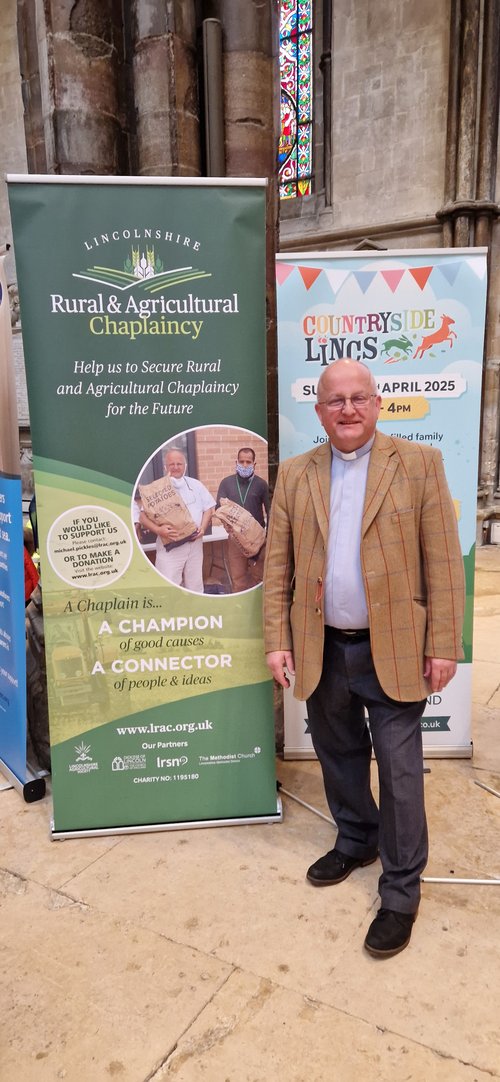
I'm Revd cannon Alan Robson. I've been an ecumenical canon for 20 years and an agricultural chaplain for 25 years. It's been a blast and I had the privilege of having that length of time to set up projects such as the charity called Lincolnshire Rural Support Network, which is a team of about 40 people including a mental health specialist group of nurses. I was also able to develop 7-million-pound project which stands for environment, people, innovation and choice, and so that was a huge environmental building on the Lincolnshire Showground. Someone told me, "You light the fire and get lots of other people to fan the flame”, and it's the way it works for me. I'm a big-picture thinker and contemplator. I don't do details, but I see the bigger picture. Chaplaincy is about enabling new connections. So the four words I have for my chaplaincy are comforter, catalyst, champion and connector.
The core to it is, with my colleagues in the Lincolnshire Rural Support Network, meeting the multiple crises that are going on at the minute with the government's new tax regime and issues around climate change such as most crops have levelled out in yields. We need more research and development. Climate change is making flood events and dry events more frequent as we have experienced in Lincolnshire. What I do as a chaplain is have a word with the bishop and say, will you host a group of farmers or Environment Agency people in a room to talk about what's going on, and could you raise something in the House of Lords? Bishop Stephen Conway has been very good with that. Being able to address the issues from the voice of the farmer is important. Over the past 20 years, each bishop has hosted events when there's been a crisis in dairy or a crisis in the pig industry. In the last 5 years, we've had avian flu that knocked out 4 million birds. We had a disease called PMWS (Post-weaning Multisystemic Wasting Syndrome) about 15 years ago which wiped out a quarter of the British pig herd. So when there's a crisis, we get down the farm drive and try to support and guide people to find solutions or face new possibilities. In Lincolnshire, we have some of the best farming entrepreneurs in the country and it's a privilege to mix with them and explore what their mission and vision is. And the church could learn probably, from the mission and vision of some of these most forward-thinking companies.
When I attended the Festival of Chaplaincy dinner in April, there were over 500 people and I would think 90 per cent of them hadn't thought about chaplaincy or understood what chaplaincy was. Above the Cathedral Choir, there were words flashed up, caring, compassion and connecting, and I got a sense of a recall, a refresh, calling to the chaplaincy. But, before becoming a chaplain, I had refused two or three times, until I received a very strong sense of call one night. I was a superintendent minister at the time, just settling into a new circuit, and Bishop Bob Hardy and the Chair of the time, Revd Dr Peter Sulston, could see that there were going to be problems within the farming industry. I've always worked trying to meet needs and I think my calling has always been about finding where the need is.
Methodism is about God for all, and all people can experience something of Other some call God and find their own particular vocations. Wesley gave a lot of freedom to people to explore faith, and unfortunately, as the Church developed after John Wesley's death, we split into many factions of Methodism and in Lincoln, there were five different circuits, and I think that's been crippling for the witness and mission of the church. I think Methodism needs to rediscover an adaptable, flexible sort of ministry, and that's exactly what chaplaincy does. A chapter in Ecclesianarchy by John Williams is about chaplaincy and it’s one of the best I've read. One of the quotes from the chaplain says that ‘Chaplains are like canaries in the mine. They should be able to point to the dangers’, and Methodism had that knack, and I use the past tense, we need to find it afresh. Our demographic has changed and there's huge amount of experience amongst our older members, but we need to engage. And I think chaplaincy; it's the fastest area of ministry growth. People are not wanting to be clergy or even deacons, but hundreds want to be chaplains to connect with people where they're at.
It’s more difficult than I expected because I've encountered hundreds of people throughout my journey. I think I’d rather acknowledge that I’ve received as much as I’ve given. I have a stole that represents my agricultural chaplaincy, and it was funded by a generous man named Robert Needham when I became a canon over 20 years ago. Robert was a farmer, known for his generosity, hospitality, and kindness. He greatly promoted the chaplaincy. When he learned that I was going to be made a canon, he thought we should get a gift for the occasion. He organised a collection in the room and people generously contributed. With the money raised, I purchased the stole. I wear it at every funeral, and while I don’t adhere strictly to liturgical colours, it holds deep significance for me. I remember Robert’s openness and kindness and I hope I have been similarly open, confidential and supportive to the many families I’ve worked with, including those who have lost partners to suicide.