Queer Faith and Art
03 February 2026
03 February 2026
For much of their early life, Grace felt pushed to the margins of Christian spaces. As a queer performance artist, Grace often sensed that their identity and faith were seen as incompatible. “I grew up feeling like Church wasn’t a place for someone like me,” they said, “I didn’t feel welcome and I didn’t feel safe.”
Today, that story looks very different. Grace now worships regularly at Union Methodist/URC Church in Margate, often accompanied by their beloved pet rats, creating art for others who fear stepping into a church to encounter faith without judgement.
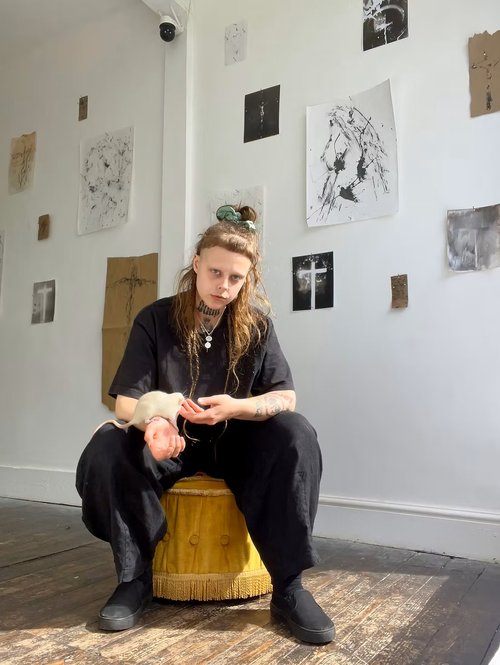
“My art is for those who have felt ousted by the Church for being LGBTQ+ or non‑binary or trans,” Grace explains. “It’s for anyone who feels a call to attend, of any denomination or none, but who has been afraid of the Church. These people do not need to be so afraid, because not all churches are judgmental and not all Christians are 'like that'.”
Grace builds art around what they call ‘faith deconstruction’. “I was born into faith and culturally consumed by it,” they said. “But I saw too many faults, too many beliefs I couldn’t sign up to. You have to take a step back and decode what is actually faith and what is not. Who can you can trust, whether that’s yourself and your own judgement, or the preacher.”
Grace grew up attending an Anglican church before being sent to a Catholic convent school. Grace remembers “an aura of discontent with everyone that wasn’t them", and recalls being taught to fear God rather than feel loved. “I didn’t like the implication that you are born a sinner, that something is wrong with you from the moment you’re born.”
At university: people began “coming out” to Grace as Christian. “It was as if it was a special occasion, like they were coming out as gay.” “They’d been Christian their whole lives but it was almost a secret. They didn’t want anyone to know. These were my friends and they were Christian. That wasn’t adding up in my head. I thought Christians were full of hatred. It took me a long time to understand that Christians were not all the same.”
Grace explored other religions, “shopping around”, as they put it, but found the same barriers.
After moving to Margate, Grace’s therapist encouraged them to try attending church again. It took courage and several false starts.
“I kept walking up to Union Church at service times and running away,” Grace admits. “It took so long for me to actually go in.”
When Grace finally stepped inside, they found something entirely unexpected.
“It was the weirdest church ever. School lunch tables, chairs everywhere, a lady talking about Jewish mysticism. I thought, ‘What is happening? This is not like the Mass I am used to.’ But nothing felt wrong about it. So I stayed. I didn’t run away. I kept telling myself, ‘This is fine, this is fine.’”
That was more than two years ago. Since then, the congregation has become a spiritual home where Grace and the rats are welcome.
“My old rat had died and the other was left on its own, but you’re meant to have at least two, so I took him everywhere. I started bringing him to church in my handbag and everyone was very excited. They take turns coming to church now, where they are so loved.”
Grace’s art explores the relationship between Christian spaces and those who have felt to be made unwelcome.
“Church buildings can be terrifying for those who have had bad previous experiences. People don’t want to walk into them. So I create sacred spaces outside of church, spaces that feel religious but are in places where people feel comfortable.”
Many of Grace’s installations are immersive with darkened rooms, candlelight, soundscapes and spiritual imagery. "I’m creating a space where you can feel safe to be anxious.”
One of the installations featured Grace’s work Anonymous Saints depicting figures without skin, showing only muscle and sinew. “I was removing The Complicated,” Grace explains. “All that’s off‑putting about Church and religion, the idea that you have to know every detail to understand anything. These saints are about having someone to congregate with without judgement. Community is what people are missing, especially LGBTQ people.”
Grace’s work is grounded in their Christian faith, a faith that has been renewed and strengthened by the welcome found at Union Methodist/URC Church.
“My Christian faith guides my art,” Grace says. “I want to show that not all Christians are scary or against you. I want people to know there is a place for them. There is a church where they will not be judged. There is a community waiting to love them.”