Living in the Holy Land: Hearing the Divine Whisper
16 December 2025
16 December 2025
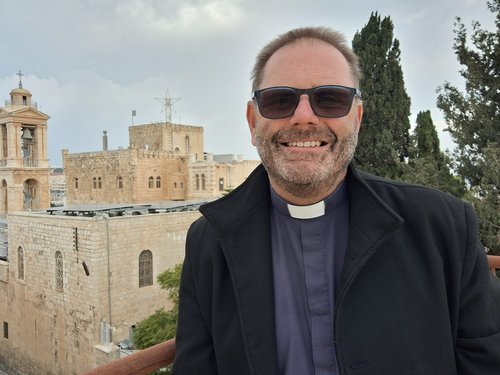
The Revd David Hardman, Methodist Liaison Officer, Jerusalem shares his thoughts on being in the Holy Land this Christmas.
I am often asked: What is it like to live in the Holy Land? Does walking through biblical landscapes and visiting gospel sites make you feel closer to God? At times, it feels like a privilege to stroll through Jerusalem’s Old City along the Via Dolorosa, passing the Church of the Holy Sepulchre, or to drive through hills that echo with scripture. Yet, truthfully, these experiences do not automatically draw me closer to God. Sometimes, though, amid the noise, I catch the divine whisper.
People also say, what better place to spend Christmas than Bethlehem, where it all began? This year, Bethlehem will have a tree, lights, and a sense of celebration, unlike the past two years when darkness hung heavy over Palestine under the shadow of Gaza. But is it really the best place to celebrate Christmas? At times, I think being back in the UK would feel more festive, even if that meant being immersed in toy services, Christingles, carol singing, Christmas meals, and family gatherings, with barely a moment to pause until the last dish is washed on Christmas Day!
Why do I feel this way? Because here, in the land where Christ was born, there are daily reminders of the sinfulness of our world and its impact on ordinary lives. The birthplace of the Prince of Peace is surrounded by Israeli Defence Force (IDF) checkpoints. My phone buzzes regularly with alerts of shootings, IDF military incursions in Palestinian communities, tear gas, home demolitions, violent Israeli settler attacks leading to Palestinian communities being uprooted from their land. And the divine whisper struggles for breath.
This is the place where God chose to reveal the Divine in human form, a land under occupation, as it is now. A region yearning for freedom and peace, as it does today. A part of the world desperate for salvation from oppression, as it is in this moment.
The incarnation was a whisper, a baby’s cry against the clamour of empire. Brutal rule dehumanises, and the cries of the oppressed are ignored by the powerful. On that first Christmas night, the cry of a newborn broke the silence - a cry for food, for warmth, for love. In that fragile sound, the divine was heard, not in power or grandeur but as a human being longing for the most basic needs of life.
As Jesus began his ministry, a deeper cry was heard. Opening the scroll of the prophet Isaiah, he chose to read: “The Spirit of the Lord is upon me; He has anointed me to bring good news to the poor… to proclaim freedom for the oppressed.” In that moment, the cry of the divine, through human lips, was heard for justice, for hope, for liberation - for all.
God’s incarnation was not unveiled in centres of power, nor in mansions cushioned by wealth, nor in tranquil beauty spots. It was revealed in poverty, under occupation, amid injustice. Why? Because salvation, through the incarnation, is not found in power or privilege, but in restoring humanity where it has been lost.
At Christmas, Christians worldwide turn their gaze to Bethlehem. But what do they see? A romanticised nativity: a willing donkey, carrying a pregnant girl, led by a dutiful fiancé! Maybe, a benevolent Inn Keeper offering his stable for the ill-prepared couple! Or a lowly cattle shed in David’s Royal city and shepherd seated on the ground while above them are angels from the realms of glory!
Yet, if we look closely, scripture tells a harsher truth: a young couple, with a child due any minute, forced to travel by imperial decree, that new-born child laid in a feeding trough, the family fleeing for their lives as Herod slaughters innocents. The incarnation was a fragile whisper against the harsh realities of occupation.
Today, that whisper is still fragile. There are those who cannot travel from Nazareth to Bethlehem because Israel deny many Palestinians permits, close checkpoints or simply do not give them passage through. Bethlehem, under Palestinian authority, is off-limits to Israelis by Israeli law. Hotels stand empty, tourism crippled by two years of war on Gaza and the lingering effects of COVID. Shepherds on Bethlehem’s hills guard their flocks against Israeli settler violence. And in Gaza, even under the so-called ceasefire, children continue to die, killed by bombs, bullets and starvation, adding to the more than 20,000 children already killed in the past two years.
In November, Palestinian Christians published Kairos Palestine II: A Moment of Truth – Faith in a Time of Genocide. This powerful document calls on churches worldwide to amplify the divine whisper of the incarnation and speak with clarity and courage about the reality in the Holy Land. It urges Christians not to adopt the narrative of the oppressor but to name the truth: Apartheid, genocide, and settler colonialism - the lived experience of the occupied.
The churches of Palestine invite Christians everywhere to embrace costly solidarity: to stand alongside all people of faith and conscience who resist injustice, and to engage in active, non-violent resistance. One practical expression of this solidarity is supporting the Boycott, Divestment, and Sanctions (BDS) movement, a call for economic and political pressure to end oppression.
The document begins and ends with a vision of hope, a day when:
“We shall live free in our land, together with all the inhabitants of the earth, in true peace and reconciliation - founded upon justice and equality for all God’s creation, where ‘mercy and truth meet and righteousness and peace kiss each other.’ (Psalm 85:10)”
This is not merely a dream; it is a prophetic call to action. It reminds us that peace without justice is an illusion, and reconciliation without equality is a lie. The Kairos
document challenges the global church to move beyond words to deeds, to embody the Gospel in the Holy Land that is crying out for liberation.
These are not the stories we naturally share at Christingles or carol services. Yet when we sing Joy to the World and claim that the Saviour of the world has come, dare we ignore pain, oppression, injustice and death not only here, in the Holy Land, but in our communities, our country and across the globe?
So, what is it like for me to live in the Holy Land? It is a struggle, a struggle to hear the divine whisper beneath the roar of fighter jets heading to Gaza, the cries of the oppressors, the pleas of the occupied and the silence of the powerful. Yet the whisper persists. Speaking clearly and plainly that God’s love, land and world is for all people, that oppression, injustice and war have no place under the rule of God. A whisper that calls people to live differently and recognise that Zion is a place where the wolf and lamb shall lie together and where weapons will be turned into ploughshares and nations will learn war no more.
For a child has been born for us, a son given to us; authority rests upon his shoulders, and he is named Wonderful Counselor, Mighty God, Everlasting Father, Prince of Peace. Great will be his authority, and there shall be endless peace for the throne of David and his kingdom. He will establish and uphold it with justice and with righteousness from this time onward and forevermore. The zeal of the Lord of hosts will do this. (Isaiah 9:6&7)