Mine be the Glory
The enduring relationship between coalminers and Methodism
15 July 2025
15 July 2025
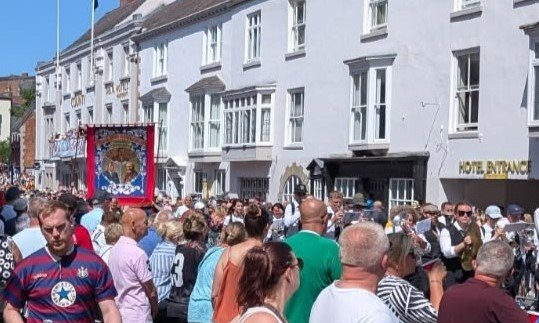
The 139th Durham Miners Gala took place in July. Around 200,000 people attended this annual celebration of community, international solidarity and working-class life.
Local circuit EDI officer, Stuart Lawson, explains the relationship between the Methodist Church, the mining community and its legacy, with Durham Methodist Church still playing an active part of the Gala.
In the coalfields of 18th and 19th-century Britain, two forces shaped the lives of working-class communities more than any others: mining and Methodism. The backbreaking labour of coal extraction, with its dangers and hardships, forged a unique social world—one where religion, especially Methodism, provided spiritual strength, moral guidance, and a sense of community. The bond between miners and Methodism was not merely incidental; it was a defining feature of industrial working-class culture for more than a century.
Wesley's decision to preach outdoors to working people, including miners in places like Kingswood near Bristol, Newcastle and Durham, marked a radical departure from the norms of Anglican practice.
Wesley's messages resonated deeply with miners. He spoke directly to their struggles, offering a version of Christianity that was personal, emotional, and inclusive. His insistence on regular meetings, mutual accountability, and lay preaching created a grassroots structure that aligned well with the solidarity already common in mining communities.
Chapel communities also became centres of mutual aid. Before formal unions or state welfare, Methodists organized support for injured workers, widows, and orphans. The emphasis on community responsibility helped cultivate a culture of solidarity that later fed into labour movements now sadly a shadow of what the labour movement was intended to be.
The decline of both the coal industry and organised religion in the late 20th century weakened the bond between miners and Methodism. As mines closed and chapel attendance fell, communities lost not just jobs and congregations but the social fabric that had sustained them for generations.
Yet the legacy remains. The cultural memory of the chapel—the singing, the sermons, the solidarity continues to shape narratives of working-class life. In literature, film, and oral history, the miner-Methodist remains a symbol of dignity, discipline, and resilience.
The Miners Gala in Durham, starting in 1871, has only been cancelled because of the two world wars and Covid.
Elvet Methodist Church is along the processional route of the parade which this year took over four hours to pass, with brass and pipe bands and many colliery and union banners celebrating the rich mining and cultural heritage of the area.
For many generations, stretching back we think to possibly just after the First World War if not further, Elvet Church, now called Durham City Methodists, have been providing refreshments during the day. Homemade cakes, scones and the northern tradition of Ham and Pease Pudding sandwiches and of course Corned Beef Pie are firm favourites with the hundreds upon hundreds of people who come through the doors, not to mention the bacon and sausage buns.
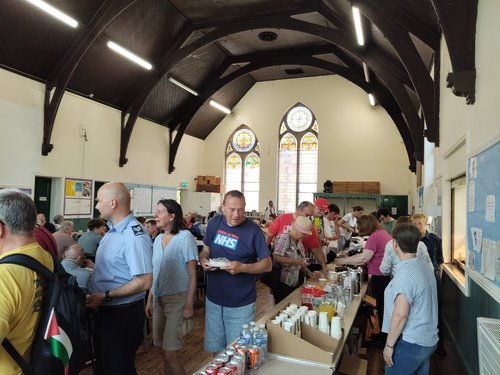
There is a great community atmosphere in the city during the Gala. Within the church, the whole church family comes together to raise money for the charity of the year, this year it is St Cuthbert's Hospice in Durham. The local Air Cadets and the Scout leaders came along to support too.
It was a long and tiring day but the benefits of the many conversations that are had, memories of past times revisited and the whole team effort is a joy to behold and spiritually uplifting. This year the church took over £3000 for the charity.
Christine Higham, one of the church stewards, said, “I feel one of the best things about the Gala today was the sheer number of folks who took time to sit in church, or to chat with us, pray, light candles etc. They very much appreciated it.”
It has been questioned that since the closure of the pits and the loss of many industries that the Miners Gala or The Big Meeting as it is also called in Durham is no longer the gathering of those involved in the heavy industries that made the area. However, there is and will continue to be that sense of a unifying spirit, that long held tradition of fraternity, support and together with mutual respect and understanding.
Durham City Methodists has been there and will continue to be there celebrating and bringing food for the body and the soul to all who attend the Gala.