Reflections on COVID-19
Two MHA staff consider the long-term emotional impact
20 August 2025
20 August 2025
Last month the Covid public inquiry heard from representatives of the care sector as part of the inquiry’s remit to examine the UK’s response to the Covid-19 pandemic. Methodist Homes (MHA) contributed to the stories in the Every Story Matters document and the charity’s experiences were fed into the inquiry through its trade body, the National Care Forum.
Here, two professionals from MHA, Dawn Ellis, a chaplain and Helen Press, MHA’s Senior Nurse Advisor, reflect on the pandemic’s long-term emotional toll and the resilience of care workers during the most serious public health emergency for generations.
Dawn has been the chaplain at MHA Waterside House in Wolverhampton for almost eight years, and saw the emotional strain of the pandemic, both for the residents and the care staff who supported them.
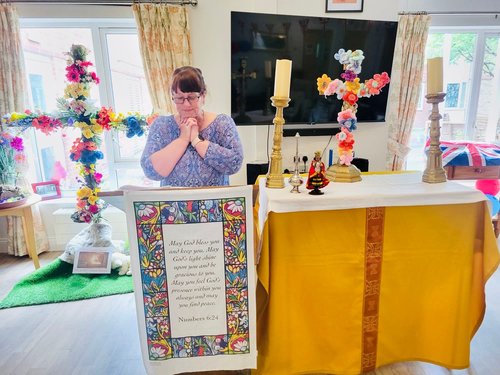
As the lockdowns began to take hold, MHA Waterside House remained open, continuing to admit new residents, many from hospitals.
With the situation deteriorating, staff were left grappling with a lack of official guidance and suitable resources. “There was no testing for us. The guidance around PPE (personal protective equipment) kept changing and people were fearful of catching the virus and taking it home to their families. It was emotionally draining.”
As the pandemic took hold, the home began to lose residents to Covid. While the staff were accustomed to the realities of loss, the scale of the pandemic was overwhelming. "When we lose somebody, it’s like losing someone from our family. During COVID, we hadn’t even had time to process one loss before we experienced another.”
Eventually Dawn contracted COVID-19 herself and had to be hospitalised. “I felt guilty for not being there for my residents,” she admitted. “From my hospital bed, I was still doing video calls to support families.”
Despite the struggles, Dawn found strength in her role as Chaplain to provide spiritual support for the residents, staff and families. “We were blessed that, even when churches were closed, we could continue to hold services for residents,” she said. “Worshiping together gave me strength and reminded me of God’s presence, even in such difficult times.”
One poignant moment of reflection came when, after a series of losses, Dawn spoke with her spiritual director about the overwhelming amount of grief she was witnessing. “I remember asking, ‘Where is God in all of this?’ I felt abandoned, like all I could see was sorrow,” she recalled. “But my director encouraged me to look for one blessing each day. The next day, I was doing a window visit with a resident, and a little bird perched on a branch outside. The resident saw it, and it cheered her up. That was my blessing for the day.”
“During COVID, everyone seemed more caring. We saw people step up and support each other in ways we never expected. But God's promises never changed. We were never truly alone.”
As time has passed, Dawn is concerned that people are beginning to forget the emotional impact of the pandemic. “There is still fear. No one wants to go through that again. But we need to remember the lessons it taught us, to care for one another and to seek the blessings, even in the hardest times.”
More than five years on, the emotional scars of Covid remain for many says Helen, “Some of my colleagues still become emotional when they talk about their experiences. “They saw multiple residents pass away in the space of a week. There was pressure from the NHS to accept patients from hospitals while staff had to deal with shortages in personal protective equipment.”
“I was frightened,” she admits. “But I had to stay calm at the time for everyone on the frontline who needed my support. I was also shattered. Switching off, even for a moment, was difficult.”
Yet amidst the hardship, there was unity. “We supported each other. We pulled together under enormous pressure to be the best we could be.”
Faith played a vital role during the crisis for many. Members of Helen’s own church knitted small hearts for use in MHA homes where one heart was placed with a dying resident, while the matching one was given to the family. “It was a symbolic connection when physical contact was not allowed,” says Helen. “It was touching to see how many people got involved without seeking recognition. That was God at work; quietly, compassionately.”
One of the most heart-wrenching consequences of the pandemic was the disruption to the grieving process. Families were often unable to be with loved ones in their final moments, or to hold funerals that properly honoured their lives. “I still hear stories about the heartbreak of not being able to comfort loved ones while they were dying,” says Helen. “The pain of not saying goodbye properly is something many are still carrying.”
“We gave everything we had,” she says. “And we’ll carry those experiences with us always.”