A Candle in the Night
24 November 2025
24 November 2025
There is a church where more than a hundred people, many of them young, mostly unchurched, step inside to pray. Since opening its doors for a weekly Friday-night vigil three and a half years ago, over 15,000 people have accepted the invitation to enter the medieval church of St Mary's in Guildford to light a candle and pray for peace. This takes place in the heart of the town, attended by the stag and hen parties, students in fancy dress and clusters of friends who are heading home from pubs and clubs. The invitation is simple, to pray for peace.
Nigel Campion-Smith is a member at St Mary’s, a joint Anglican and Methodist church. Nigel was one of those behind Common Ground’s initiative which began monthly 'Night Vision' sessions inviting people in at the gate some years back. “We were planning a February 2022 session with a theme of love,” he says. “But, the night before the session, Russia invaded Ukraine. We changed the plan and invited people to come in, to light a candle and to pray or just reflect. A lot of people came in that night.”
The response reshaped the ministry entirely and peace became the central theme. “It inspired so many,” Nigel explains. “While it is hard to turn down an opportunity for a more peaceful world, people also asked if they could light a candle for friends, for family, for situations they’d heard about on the news. It became a shared act of hope.”
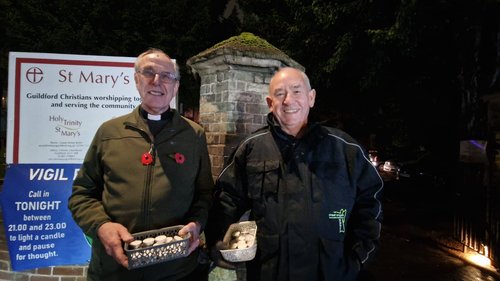
Each Friday from 9.00pm–11.00pm, two volunteers stand at the church gates, where they extend a simple invitation, to light a candle for peace. One of them, Michael Lee, describes how unexpectedly positive the reaction has been. “It’s quite a step to stand out on the street and invite pub and club goers to pop in,” he says. “But people are remarkably positive. Nobody has ever been rude about it. They’ll say, "I’m not dressed for church", or "I’ve had a drink". But we tell them that’s not part of the deal, everyone’s welcome.
The church sits on a road from the town centre, used at night more by pedestrians than cars. A short path takes people from the gate to a welcoming church porch. Visitors are greeted inside and invited to light a candle. The lighting is low, a gentle purple, one of the colours of peace, with rows of lit candles on the altar steps.
A seemingly constant stream of people, in groups, in couples and individuals, all solemnly walk to the steps, place a candle and pause, many retiring to a chair for further reflection. There are people sitting in most of the rows. Many have heads bowed. The atmosphere is respectful rather than solemn, a place safe to be with friends or alone. A rolling on-screen display shows suggestions of locations around the world where a prayer for peace would be welcomed.
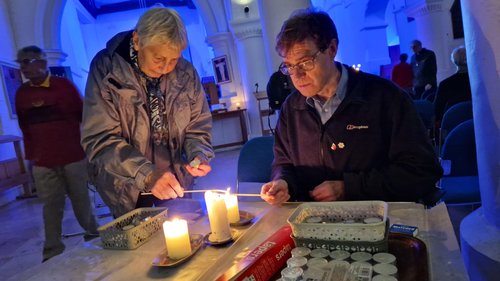
Some chairs are used by people sitting alone in prayer and thought, others by groups. In the front row, with party hats and a balloon, a group of partygoers sit quietly. One of the young women explained that they were walking between pubs to celebrate a birthday, but they had come in to remember friends and family, “We came in to think about them for a bit”.
“Only last week a student came in whose friend had taken her own life,” recalls the Revd Dr Paul Glass, Superintendent Minister at St Mary’s. “She’d been out with friends, saw the church was open and came in. We prayed with her. She found it deeply helpful.”
This gentle, unobtrusive approach is part of what makes the vigil so accessible. “We don’t invite people to do anything except enter a beautifully-lit building and light a candle,” Paul says. “It isn’t a service. There are no expectations. They can take as long or as little time as they need.”
The peace ministry has sometimes welcomed those who can shed light on life in the war zones being prayed for. The vigil has welcomed the UK Ambassador to Ukraine, who spoke on an anniversary of the invasion. The Anglican Archbishop of Sudan, Ezekiel Kondo, attended one evening before the vigil began to talk about the violence there, a conflict not often absent from mainstream news.
The Archbishop had been invited by Andy Wheeler, a retired Anglican priest, who had worked in Sudan for 25 years. For Andy, the power of the vigil lies in the way it gives people permission to acknowledge what they carry emotionally. “People have seen candlelit vigils on television,” he says. “They may never have taken part in one themselves, but they understand the symbolism. People carry anxiety, compassion, distress about Ukraine, Gaza, Sudan, as well as their own bereavements. Our society doesn’t give many places to take that. So when they find a church open, inviting them in, it’s extraordinary.”
“It's been one of the best things I've done in my Christian ministry. Frankly, never before have I had so many opportunities to just talk about life and faith and people's journeys with people who really have no church connection at all.”
Other members of the team can find the vigils equally rewarding. Rosemary describes the evening as “the last place people expect to find themselves on a Friday night in Guildford. But they come in, and they find something they didn’t expect, something that could be life-changing. For us, it’s a privilege to share time with them.”
Alwyn Marriage is another volunteer, “It’s so moving. There are no strings attached. People come because they want peace. Many would never normally come near a church.”
St Mary’s has become a place where strangers acknowledge griefs and worries and maybe pray for the first time in years. Where, as one young woman declared when she returned with friends a few weeks later, “This is my church now.”
Alwyn Marriage have written this poem as a reflection on the vigil.
They are not fooled, the young.
Even the clatter of adolescent
or early adult life can't stem
for them the tsunami of each
day's bad news. It's not their fault
they have internalised the global
war-torn map and are already
acquainted with night's mental
videos of cruelty and catastrophe.
But ever since the day that Russia
overstepped the mark into Ukraine,
hundreds of teens and twenties take
a break from pubs and clubs each Friday
night to visit, briefly, the oldest church
in town, to light a candle for peace.
Soft lighting guides their way towards
the chancel where, on three stone steps,
scores of candles illuminate the darkness,
flickering with all the urgency of youth.
A constant stream of energy flows in
through the open doors: short-haired lads
from the army barracks, scantily-clad
hen-party girls with bunny ears, pierced
navels, brows and noses. Neither rain nor
snow, or even rugby internationals will keep
them from this place of undemanding welcome
where, no strings attached, they can simply,
wordlessly, state their longing for peace.
They come in fours or fives, singly
or in pairs, bearing tiny flames of hope.
They plant their candles carefully among
the others, hover or sit looking at the light,
stand quietly a while, then leave.
Some might wonder what, if anything,
is achieved by this show of solidarity;
but it feels as though the town is changed
a little by this weekly ritual – as also, clearly,
are those never-be-seen-dead-in-a-church
Friday-night revellers who have chosen
in this way to commit themselves to peace.