Blue Plaque to Kamal Chunchie Unveiled
04 June 2026
04 June 2026
A Methodist preacher and pioneering race relations campaigner has been honoured with a blue plaque marking his life.
On Tuesday, 2 June, Vice-President Matthew Forsyth was among guests to witness the unveiling on the wall of Jeremiah Street, London, in honour of Kamal Chunchie. Kamal fought against racism in the capital and across Britain and founded an institution to campaign for improved race relations more than 100 years ago.
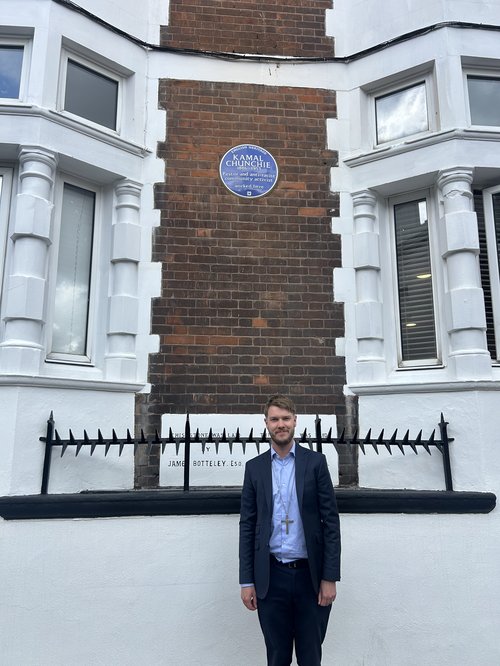
He was also honoured with the naming of the new Kamal Chunchie wing at the Queen Victoria Seafarer’s Rest (QVSR) – a charity founded in 1843 to support merchant seafarers providing accommodation, welfare services and community programmes.
Born in Sri Lanka in 1886, he served in the British Army in the First World War, as a firefighter in the Second, was a prominent cricket player and found God after his experience of the trenches.
His fascinating work will now be permanently marked with the blue plaque in London’s docklands where so much of his life was spent.
After enlisting in the British Army in 1915 in the Public Schools Battalion, 3rd Middlesex Regiment, Chunchie fought in both France and Salonica (now Thessaloniki), Greece, bearing witness to the terrible slaughter on the Western Front before becoming a Christian while at a convalescent camp in Malta.
Returning to the UK in 1918 at the war’s end, he married a Welsh woman and the pair lived in London’s East End. Here they witnessed the terrible discrimination suffered by Black and Asian people in the area, many of whom had served Britain during the war.
By 1921, he had found work in the Wesleyan Methodist Missionary Society as a missionary among foreign sailors and in 1923 he launched the first Black Methodist church and Sunday School in a rented hall in Swanscombe Street, London.
Perhaps Chunchie’s best-known act came in 1926 when he set up the Coloured Men’s Institute in Canning Town – believed to be the first community organisation of its kind.
Chunchie travelled widely throughout Britain, raising funds for his work, and played cricket for Essex from 1935 to 1937. At the outbreak of World War Two, he volunteered as a firefighter and helped tackle blazes caused by German bombing in the Lewisham area of London.
He died in 1953.
The pioneer in race relations has already been honoured in his adopted home city, with the road leading to the London City Hall in Newham named Kamal Chunchie Way in July 2021.
Vice-President Matthew Forsyth said: “I had the privilege of attending the unveiling of a blue plaque in honour of the life and story of Kamal Chunchie, at the QVSR in East India Dock.
“It was a moving and important moment, not only because of what was being remembered, but because of what that remembering might now make possible.
“The story of the Methodist Kamal Chunchie is itself a remarkable one. One which led to the road of the new Greater London Authority to be named in his honour. You might say, before we ever had a justice, dignity and solitary strategy Kamal was among many people called Methodists living this commitment to life out.
“The new wing named after Kamal Chunchie itself was unveiled by Baroness Lawrence of Clarendon, which gave the moment an added depth and dignity.
"What stayed with me most was the reminder that oral history is not simply about the past. It is about the future. It is about which stories we choose to carry, which voices we choose to amplify and what kind of society we are trying to become.
“Kamal Chunchie’s story is extraordinary, but part of its power is that he also seemed to be an ordinary person who chose to do extraordinary things. He saw need. He saw injustice. He saw people pushed to the margins. And he responded with courage, faith, hospitality and practical love.
“In a world where so many stories are still overlooked, the day felt like an invitation to listen more carefully, remember more honestly and ask what ordinary acts of courage might be required of us now.”