Izzy: Artificial intelligence, ethics and Methodism
24 April 2025
24 April 2025
Izzy has just completed a master’s degree in data and artificial intelligence ethics and has started work as a project coordinator for a virtual reality programme to help people overcome speech anxiety.
Her early experiences of church and faith were not good but, when she went to university, she found God. She is now church council secretary at Castle Street, the upcoming Helen Kim Memorial Scholar, and has made a huge contribution as a member of the Methodist Church’s AI working group.
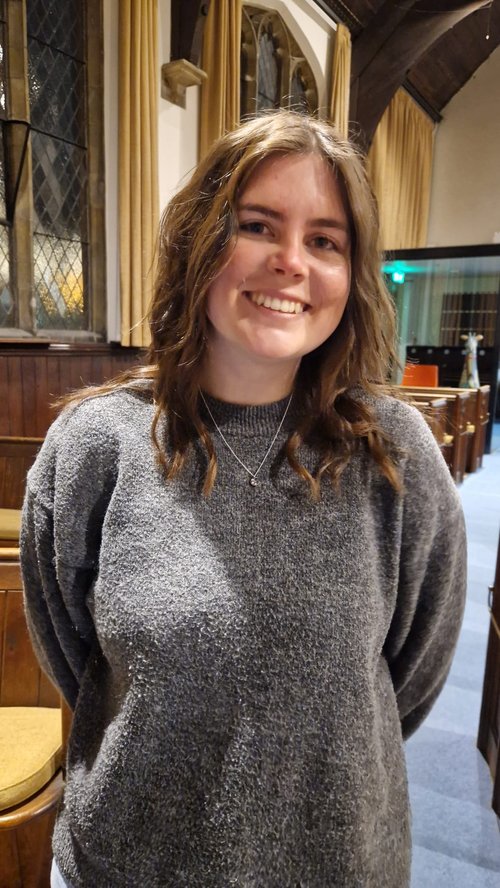
My friend and I went to Castle Street Methodist Church together, I wanted to see if there was a way of doing faith that felt right for me. It was a world apart from what I thought faith could be. Everyone was smiling, within five minutes, I felt safe, warm and cared for. It was so lovely, I just had to keep coming back and chasing that feeling.
When I was a bored teenager during lockdown, I entered an essay competition entitled “Could you be friends with a robot?” I really got into it. My conclusion was: you can be friendly towards a robot, but you can't be friends, because there's the human element, which I now see as that something special that only God can give us. This eventually led me to completing an MSc in Data and Artificial Intelligence Ethics, with my dissertation completed as part of my work with the Methodist Church.
What I discovered from working with the Methodists was ‘something special’ that you can't get out of a computer, that we must remember to value. The opening of my dissertation featured someone I'd spoken to who had started using artificial intelligence to write all their prayers as they didn't think theirs were good enough. I came to realise that the metrics that we use to judge technology – how fast, how accurate it is – is not what we should be using to judge ourselves. Your kindness and your thoughtfulness and your feelings, your anxieties and vulnerabilities are what makes you.
I've met a lot of people through the AI working group, and heard from many through the survey I ran, whose feelings and thoughts I've been entrusted with. Some people were sharing their deepest, darkest fears about this technology, about their own shame in how they use it, about their anxieties. It makes you realise the responsibility you have to make sure you use the words that people have given you in the right way.
Knowing that the church was always here for me, even when I travelled with my studies, that I could always pop in, that I could just be around that family again, was really important to me. I think it was really helpful that being away in Edinburgh for my postgraduate study felt very temporary, like I had a home elsewhere.
I am also church council secretary at Castle Street. I think record-keeping is really interesting. It's really important to find the thing that you can give to the church. Being more involved makes you incredibly appreciative of what people quietly do to keep things going. When you go to church on Sunday, you don't see the extra hours that so many people squeeze in.
I am also excited to be taking over as the next Helen Kim Memorial Scholar for Britain in August. While I haven’t properly begun my work yet, I have already been welcomed in a way that makes me feel similar to when I began my faith journey: safe, warm, and cared for.
I'm part of the Methodist AI Working Group and we're going to be presenting our report to the Conference this year. Now that my studies have finished, I coordinate and deliver a VR-based therapy programme for students experiencing speech anxiety. I am so grateful that I've been able to move into a space that is connected to my studies, whilst using my skills in a positive way. This work has further deepened my interest in how technology can be used with care and compassion.
I'm really looking forward to seeing what comes of the Conference this year, and, whatever is decided, I’d love to be a part of the work as it develops.