Keeping an ideal of a Christian society alive
14 October 2026
Keeping an ideal of a Christian society alive
14 October 2026
A reflection from the Revd Dr Jonathan Hustler, Secretary of the Methodist Conference
The World Methodist Council met in August in San Salvador. Included in the programme (and for many of us, I think, the most moving part of the week) was an opportunity to visit the tomb of Archbishop Óscar Romero and his home, now curated as a museum in his memory.
I am old enough to remember the widespread shock when Romero was murdered whilst presiding at the Eucharist, but until I arrived in El Salvador I had no idea of the breadth and depth of the devotion to the martyred archbishop that there is in the country.
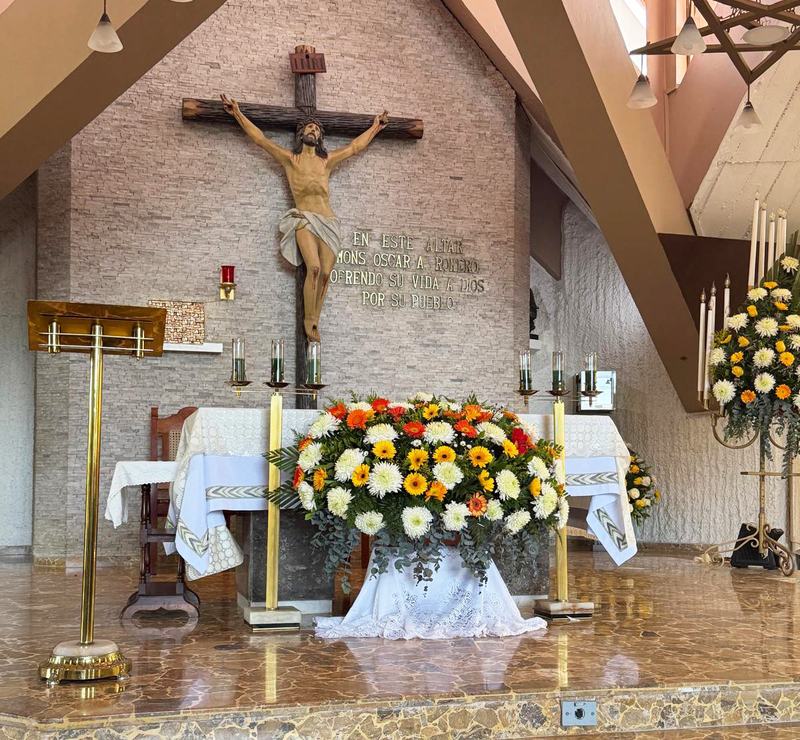
Much of Romero’s story was familiar to me but (or perhaps therefore) to stand in the place where a martyr preached, to step into the room in which he wrote his sermons, and to see the (still bloodstained) vestments he wore as he delivered his final homily was a moving experience.
There was one moment on the tour that I found particularly striking. One of the exhibits on display is Romero’s car. Our guide pointed it out and said that Romero used to drive himself, because he did not want to risk the life of a chauffeur. It was the decision of someone who was fully aware of the danger that he faced every day and when I heard that I suddenly noticed a similarity with another martyr archbishop.
My manse is in Harrow, close to the former residence of the Archbishop of Canterbury. It was from Harrow in December 1170 that Thomas Becket made his final journey to his cathedral where, four days after Christmas, he was murdered.
As Romero did, Becket recognised the danger in which he stood; in his sermon on Christmas Day he spoke about saints who had been archbishops and is reported to have said, “Soon there will be another martyr.”
That apparent prescience is not the only similarity in the stories of the two martyred archbishops. Becket had been the King’s Chancellor and a close friend of Henry II. When he was appointed primate (apparently against his will), Becket was expected, not least by Henry himself, to be willing to do the monarch’s bidding.
However, once enthroned, the archbishop identified himself with the rights of the Church, vigorously defending ecclesiastical privileges against what he saw as infringement by the government.
In 1977, Romero was seen as a conservative in San Salvador; he was not expected to become the voice of the oppressed. A pivotal moment was the murder of his friend Fr Rutilio Grande, shortly after his appointment as Archbishop. From then on, Romero was an outspoken critic of the military government and its collusion with the elites who dispossessed those who were already poor.
The day before his death, he made an impassioned plea to the members of the armed forces in his homily: “In the name of God, then, and in the name of this suffering people, whose laments rise up each day more tumultuously toward heaven, I beg you, I beseech you, I order you in the name of God: stop the repression.”
Throughout his archiepiscopate, the radical tone of Romero’s preaching, which was broadcast and heard all over the country, provoked the ire of the authorities. As the leader of non-violent opposition to the military dictatorship, he took as his motto ‘sentir con la Iglesia’ – to feel with the Church – and the Church with which he identified was on the side of the poor.
Liberation theology provides part of the context of Romero’s remarkable ministry. The meeting of Latin America theologians in Medellin in 1968 is often seen as the beginning of that movement which stresses the role of the gospel in calling the powerful to account and proclaiming liberation to the oppressed.
It would be stretching any comparison to think of Becket as being a liberation theologian, but his battle for the rights of the Church didn’t come from nowhere. Since the previous century (and the so-called Investiture Controversy) monarchs had been wrestling with the Papacy over the power to appoint, remove or discipline clergy. Becket’s ministry was an expression of a theological dispute that echoed others across the continent of Europe.
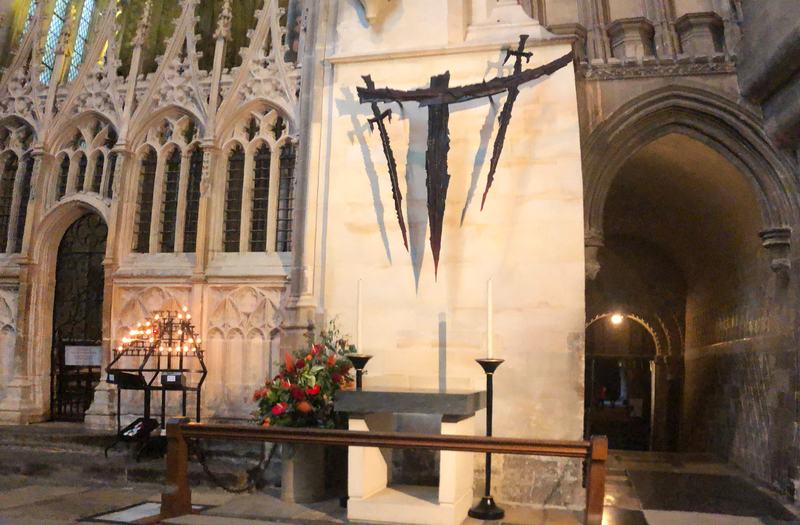
The clearest similarity between Becket and Romero, though, is in the veneration that quickly followed their death. Within weeks of Becket’s murder, stories about his sanctity and posthumous miracles were circulating in England and further afield. His body, hastily buried in the cathedral, was moved in 1220 and a shrine constructed which welcomed hundreds of pilgrims every year, quickly becoming England’s premier pilgrimage site.
The tomb is now a much simpler affair; the shrine was destroyed and the cult suppressed at the Reformation, not only because of Protestant antipathy to the veneration of saints but because it did not suit another Henry to have so powerful a symbol of the ability of the Church to thwart the will of the monarch attracting attention.
Huge crowds were present when Romero was buried. Rather than eliminating the opposition, those who killed the archbishop galvanised both it and his personal following. Romero is now revered as a saint, canonised in 2018 by another Latin American archbishop, Pope Francis, but celebrated as such in El Salvador from the moment of his death.
The stories of Becket and Romero and the subsequent prayers offered at their tombs became national and unifying phenomena. When, two hundred years after Becket’s death, Geoffrey Chaucer planned a collection of stories told by a range of people across different classes of mediaeval society, the pilgrimage of Canterbury must have seemed the obvious context. When visitors enter El Salvador, a mural depicting Romero’s ministry greets them at the airport.
The martyred archbishops represent the people; their stand against the forces of autocracy or oppression is a powerful symbol of hope for those who are impoverished; their resistance to and disavowal of violence offer hope of a better, more peaceful society.
The stories of Becket and Romero both proclaim that whilst the legitimate exercise of governmental authority is to be welcomed, the illegitimate use of power must be challenged. More, they proclaim that violent oppression will not have the final word, and people seem to understand that at a deep level that is more profound, more heartfelt, than rational argument.
At the start of the last connexional new year, in September 2025, I expressed my concerns about the rise of Christian Nationalism. In spite of those correspondents who tell me my concerns are misplaced or prejudiced, I remain worried.
Perhaps the martyred archbishops can point us to a different understanding of what it means to be a Christian nation, a nation in which the courage to resist oppression is revered and the limits of secular power and the needs of the marginalised are understood.
Edward Carpenter’s reflection on the legacy of Becket is pertinent to our times: “In dying for the rights of the [Church] as he understood them, he . . . kept alive an ideal of a Christian society.”