Net Zero success
20 July 2026
20 July 2026
A historic Methodist church will turn up the heat in their fight against climate change by using new electric heat pumps to warm the congregation, removing their use of gas entirely.
Work has been underway at Lymm Methodist church, in Cheshire, for eight years to reduce carbon emissions in buildings dating back as far as 1850.
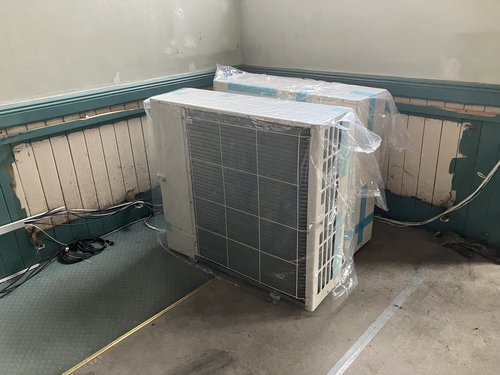
The installation of a blown-air system powered by air source heat pumps allows the church to heat individual rooms at their choosing, eliminating the need for radiators.
Lymm Church consists of a small chapel constructed in 1850 by the Primitive Methodists to which a schoolroom was added in 1865. In 1897, a new, larger worship space was built a few yards above the chapel, releasing the original chapel and schoolroom to accommodate the growing Sunday school. By 1968, the buildings were connected by a new two-storey, flat-roofed building.
The modernisation which is now underway has reducing the church’s environmental impact at its heart. Not only has a new heating system been installed, but heat loss has been reduced by insulating the church’s flat roofs to modern standards. There are also plans to install solar panels in the future.
Paul Thompson, from Lymm Methodist Church, has overseen much of the work and said that the plan was to future-proof the church for future generations.
He has documented the progress of the work with short weekly video updates on YouTube, which can be viewed here: https://www.youtube.com/@lymmmethodistchurch
He said: “It all started about eight years ago.
“The church is very close to the village centre, which is a great thing. The buildings have been well used for many years by the community, but they are expensive to heat, and access has also been a problem. We are now addressing these issues by making the buildings fully accessible and heating our buildings more efficiently and sustainably.
“In 1850 there was a leap of faith made to build this first building, in 1897 there was another leap of faith to build the brick church, and in 1968, when all the work was done to connect the buildings up, that was another big leap of faith.
“We said ‘it’s our turn’, so that our mission as Christians can continue in the village and that we have buildings fit for purpose.”
He added: “Obviously the climate crisis is a huge issue for the world and it is important that we make the move towards renewables and eliminate our use of fossil fuels.
“We now have no gas in the building. Using highly efficient air source heat pumps means that our CO2 emissions will be cut by 80%. Add to this the fact that we are on an energy tariff where all our electricity comes from renewables, and it means that we have achieved the Methodist Church’s goal of being net zero.
“Using air source heat pumps with a blown-air system will not only reduce our energy use, but also enable us to control the heating in rooms individually, which will save us money.
“Our next step will be to install solar panels, which will not only reduce our running costs further, but also enable us to share surplus electricity with the grid and become part of the solution to addressing the climate crisis. We see this as part of our Christian stewardship of the planet.”
The Methodist Church is committed to reducing carbon emissions across all its churches and buildings and has launched an ambitious drive to reduce the amount of greenhouse gases emitted from the often-historic estate.
More than 1,300 Methodist churches are signed up to the eco-church scheme with the aim of reaching net zero.