Virtual reality, real consequences
Tackling knife crime
22 October 2025
22 October 2025
Young people aged eleven to seventeen gathered for a knife crime awareness session at 3Generate that used virtual reality to make abstract dangers feel immediate and personal.
The session emphasised empathy and how to understand consequences beyond the immediate participants. Maame, 11, reflected that "you should be careful who you call your friends." Inaiya, 14, who was arrested during the simulation, learnt "that we should not depend on others to decide for us." Mia, also 14, attended to understand why people carry blades and discovered that "some people would ask for favours," revealing how peer pressure and obligation drive dangerous choices.
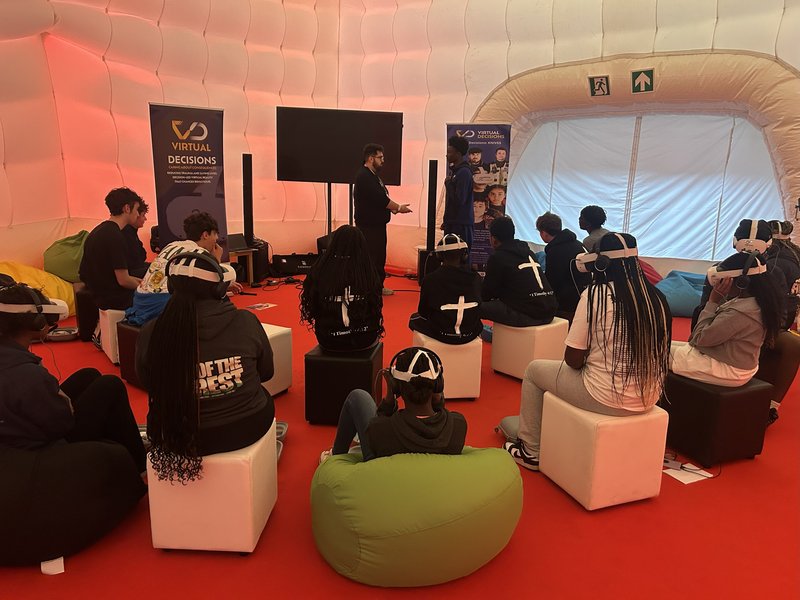
Led by Josh from Virtual Decision, the interactive experience allowed participants to make choices through VR controllers, navigating scenarios where decisions about carrying blades lead to very different outcomes. By the end of the first session, 4 out of 10 participants had been arrested for possession of a blade. In real life, Josh explained, they could face two to four years in prison.
When Josh asked why people carry knives, the answers came quickly. "Fear", said one young person. "Protection", offered another. Josh challenged this logic directly, asking whether there were other ways to protect themselves. Josh explained that blades are close-range weapons, meaning the most effective protection is simply backing away from danger. To illustrate how quickly violence escalates, he demonstrated with a volunteer how a knife fight lasts only seconds, a brief moment that can destroy lives permanently.
The discussion that followed cut straight to uncomfortable truths. The VR film itself placed participants in a park where they had to make choices about carrying weapons. Afterwards, Josh debriefed each decision, exploring why participants chose particular paths and how those choices affected everyone involved.
He highlighted characters like a young mother in the park who might call the police to protect the children playing nearby. This raised questions about perspective and judgement. Someone who calls the police might be labelled a snitch, but someone who physically intervenes becomes a hero. The context shapes how we interpret the same protective impulse.
Josh's approach combines immersive technology with role play to make abstract warnings concrete. By acting out knife attacks and their aftermath, he helped young people understand not just what happens to the person holding the blade but to everyone around them: victims, bystanders, families and communities.
"We aim to support young people to make good decisions, to have all the information to make long-term choices," Josh explains. Virtual Decision works with young people aged 11 to 18 across the UK, including those with additional needs, ensuring the message reaches diverse audiences.
What makes the Virtual Decision approach effective is its refusal to preach. Rather than telling young people that carrying knives is wrong, it allows them to experience consequences in a safe environment where mistakes teach rather than destroy.
The VR format creates emotional investment in fictional scenarios that mirror real dangers. When participants see their choices lead to arrest, injury or worse, the lessons stick in ways that lectures cannot achieve.
The combination of technology, discussion and role play gives young people tools to navigate peer pressure and fear, understanding that genuine safety comes from making informed choices rather than carrying weapons that promise protection but deliver harm.
(Image with thanks to A R Mackley)