"Christian solidarity means standing beside and supporting the local church in its steadfastness, strengthening the steadfastness of believers in the land and empowering church and Christian institutions that embody the faith-based and humanitarian mission on the ground. We renew our appeal to Christians worldwide to challenge the siege imposed on the Christians of the Holy Land, to come and visit the living stones, to witness and respond to what you see, and to help strengthen the steadfastness of the Palestinians and the Christian Palestinians among them. This is our call: “Come and see.” Then tell what you have seen, respond to it, and stand with the steadfast Church." (Kairos 2, paragraph 3.13)
After being nominated President Designate at Conference 2025 (just over a year ago) my wife and I went on holiday to Italy. I was wondering, pondering – what had I let myself in for? What might be the theme or focus of the Presidential year? Where in the world would I go to visit other Churches and Mission Partners?
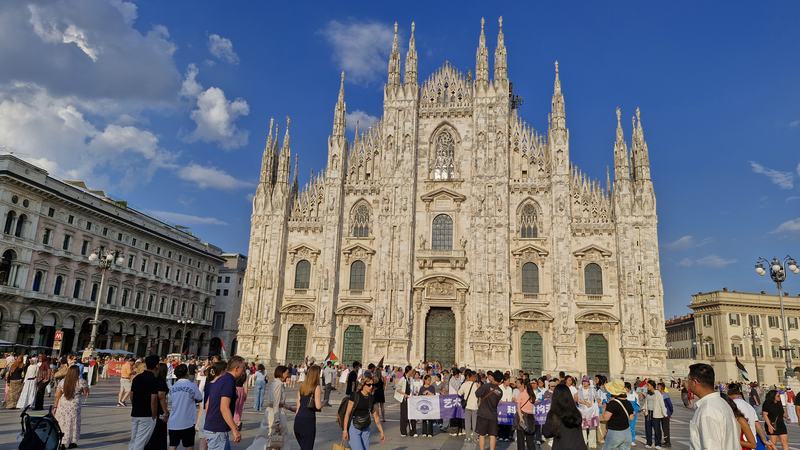
On the penultimate day of the holiday we were in Milan due to catch a direct flight to Edinburgh the following afternoon. Wandering around the city we came across a large open square with the city’s Cathedral on one side. The square was busy. In front of the Cathedral we noticed two rows of people standing, quietly, holding banners and placards. We went over for a closer look. It was a silent protest in solidarity with the people of Gaza. The placards were adorned with photos from the besieged strip of land and messages about, for example, how many children or medics had been killed.
I noticed one man, holding such a placard, with tears rolling down his cheeks. And I was overwhelmed with the desire to go and give him a hug. I turned to my wife and said, “Do you see that man on the left crying? Do you think it would be alright to go and give him a hug?”
“I’m not sure,” she said, “but you should go and if he doesn't want a hug, leave him alone and come back.”
Wise words. He accepted the hug. I held him and we cried together and I thanked him before returning to a watching, waiting spouse.
We did not know at that moment that the following February we would be visiting the Methodist Liaison Office in Jerusalem and Mission Partners in the West Bank and Galilee, but I wonder if, seven months ahead of time, that vocational invitation was already being heard, responded to and embraced?
After this summer’s Conference, where Methodists heard from Father Fadi Diab, Anglican Priest from Ramallah, and received the call of Palestinian Christians to costly solidarity, my wife and I went on our annual holiday ending in Croatia. I was wondering, pondering if there was anything more, Presidentially-speaking, to be and do in relation to Palestinian Christians or whether, maybe, what was needed was done in bringing the cause to the Conference.
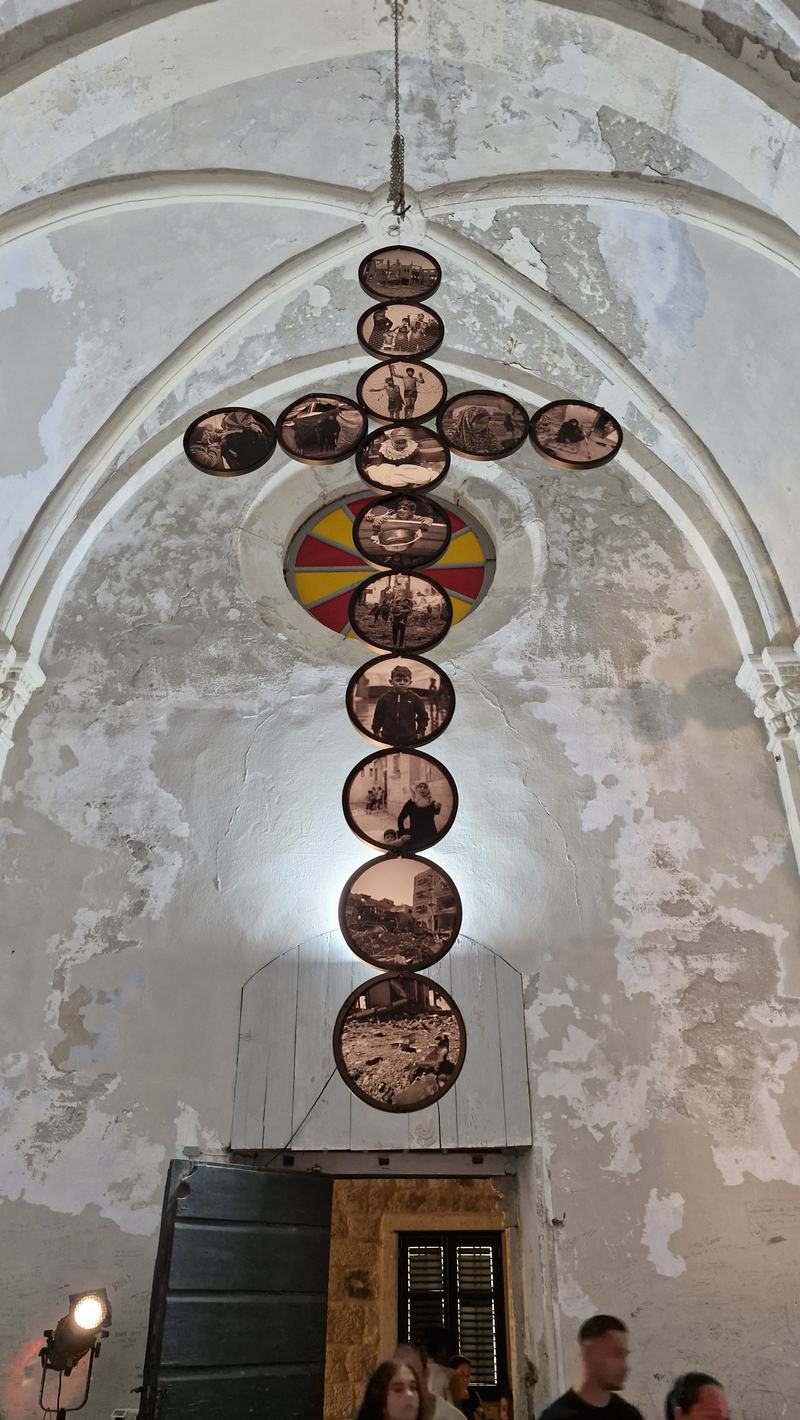
On the penultimate day of the holiday we were in Dubrovnik, due to catch a direct flight to Edinburgh the following afternoon. Wandering around the city, we came upon an open, old, wooden door in a stone wall revealing a small, simple, single-room chapel beyond. A cross made up of small, framed and connected glass circles with images in each hung from the ceiling. We stepped inside for a closer look. The Circular Way of the Cross is a two-metre-high installation created this year by Croatian visual artist Milica Bravacic. On one side of the cross each round frame holds an image from a contemplative February walk in Dubrovnik, after a storm, in which the artist came to think of and connect the suffering of Jesus with that of people in Gaza. The other side holds images from Gaza and the military action and occupation. The artist’s inspirational walk was taken on 11 February, right in the middle of our visit to Israel/Palestine.
A supervision session after February’s visit explored the sense of being commissioned to share and amplify the voice of Palestinian Christians, particularly through Kairos 2. The end of holiday experiences confirmed and affirmed a continuation of this commission.
The Conference received Kairos 2 and committed to key actions including writing to the Foreign Secretary and producing study material for the Methodist people in Britain. I am pleased to share that, after waiting to see what changes in government offices would occur over the summer, we have written to the new Foreign Secretary and Prime Minister. We await any responses.
I am currently listening to the audiobook, released in March this year, Solidarity: The Work of Recognition by former Archbishop of Canterbury, the Rt Hon Rowan Williams. The Church Times shared some of his recent address to St John’s College, Cambridge, speaking about solidarity:
"It’s not just that solidarity would be a good idea, it’s that we are already involved with one another. The dependence of your well-being on mine and mine on yours is a fact built into our very nature as speaking, thinking, social beings. It’s not that we start out as individuals and then after a bit decide actually it’s a bit more convenient to talk to other people. We are talked to before we talk. We are acted upon before we act. We are loved before we love. And somehow that is just built into what it is to be human."
We are one body made up of many involved, connected parts, none of which can dismiss the other as either more or less valued. “If one member suffers, all suffer with it.” (1)
In the Conference address I spoke of the ancient wisdom in Genesis 1:26 – how we image/imagine God to be is what we become, what we become like, how we are made. Perhaps a Trinitarian God, God in relation with God, offers us an image of Being in solidarity. I also spoke of Jesus as our image both of God and of humanity. Jesus shows us what God is like and shows us what a human being can be like. Perhaps we might contemplate and follow Jesus as the divine act of solidarity, Immanuel, God with us. Likewise, the Spirit or Advocate sent to be with us forever. (2)
"More than ever, now is a time for costly solidarity. By its very nature, true solidarity is costly. It has a price. It is a faith-based stance, a human commitment and a moral responsibility. True solidarity is also the embodiment of our shared humanity and fraternity. Either we live together — or we perish together." (Kairos 2 paragraph 3.11)
The Presidency is primarily a ministry of visitation and encouragement to churches and mission partners. Vice-President Caroline and I have begun our visits and we have already seen and experienced some profound examples of solidarity: Methodist Homes for the Aged with staff, residents and families;
Action For Children with children, young people, families and community partners;
Chaplains alongside farmers and seafarers and in local Health Practices;
Church and community work with all ages and abilities, cultures and languages, diversity and inclusion.
With all the associated joys and sorrows.
In July of this year, Brittany Shigley and Patrick Eby wrote an article titled What Is Social Holiness? John Wesley's Vision for Justice and Community, for Indiana Wesleyan University. Having reminded readers that John Wesley believed that holiness was formed in community through relationships with other people which did not stop within the walls or bounds of church but was practised in ‘works of mercy’ in the world at large, they wrote: “Social holiness is not a slogan. It is a way of seeing the world – one in which personal faith and public life belong together, and in which becoming holy and becoming useful to others are part of the same journey.”
I hope and pray to be useful to those Palestinian siblings I met earlier this year.
I celebrate those Methodist expressions of solidarity in ministry and mission that Caroline and I have already seen and are yet to see.
I invite you to contemplate deeply what solidarity you and the church to which you belong both practise, and might be called to practise, in local contexts and in relation to the cries for justice and mercy worldwide.
Yours in Christ.
Mark Slaney (August 2026)
[1] 1 Corinthians 12 v.26
[2] John 14 v.16