Tackling Homelessness
01 October 2026
Tackling Homelessness
01 October 2026
Below, the Revd Canon Ian Rutherford, Chair of both the Housing Memorial Group and the Connexional Economic Justice Working Group, shares his insights on what is needed to reduce homelessness.
His experience of the subject is vast, working as a solicitor supporting marginalised people, as the chair of a housing association, and then as a Methodist minister with a passion for social justice. This led him to convening a group of Christian leaders that engaged with local MPs, and civic and business colleagues, leading to the establishment of the Doncaster Homelessness Partnership. He then became City Centre Minister at Methodist Central Hall, Manchester, where he worked with civic, business, voluntary sector and interfaith leaders to tackle homelessness.
The overriding priority for addressing homelessness is prevention. But that wasn’t the case when I arrived in the city of Manchester in 2017. In my role as the Faith Sector Lead for Andy Burnham, the then-Mayor of Greater Manchester, I worked within the Greater Manchester Homelessness Action Network to develop a rough sleeping strategy focused on reduction, respite, recovery and reconnection.
The focus had been on emergency food and clothing provision – essential, but not effective at tackling the root causes of homelessness. What was missing was the upstream work: prevention, or as we termed it, reduction.
In 2018, the freezing temperatures brought by the ‘Beast from the East’ meant scores of people sleeping rough spent two weeks sheltering at Methodist Central Hall. Ironically, this gave the support team the time they needed to help them start turning things around.
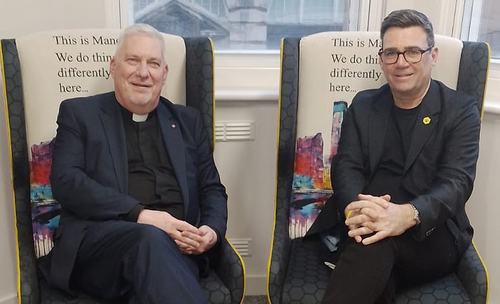
As a result, following a conversation with the Mayor, the A Bed Every Night scheme was born, providing a bridge from respite to recovery and enabling a shift to a “names, not numbers” approach.
We found that 54% of people on the streets were under the age of 35. This led to the creation of a youth pathfinder programme, which aims to prevent homelessness from happening in the first place.
Run by the Greater Manchester Better Outcomes Partnership (GMBOP) the Pathfinder Project is for those aged 18–25 at risk of homelessness. It helps young people with wraparound interventions, including mental health support, financial guidance, LGBTQ+ services and mentoring. Each person is treated as an individual – with choice, agency and tailored support.
A Bed Every Night taught us that this scheme and others like it couldn’t be run on a purely voluntary basis. It needed to be properly funded, coordinated and supported across sectors.
Then came the pandemic, which taught us another vital lesson; the programme had to evolve, moving towards single, self-contained spaces, with dignity and safety at the core.
We continue to listen to people using our services, review the data and ask ourselves what we can do better. Crucially, the programme has also been independently evaluated by Heriot-Watt University.
The faith contribution to addressing homelessness is defined by the focus on human dignity, agency and compassion. People of faith instinctively understand that the work must be done with people, not to them.
There are powerful examples across the country. Barnabus in Manchester runs a drop-in centre that radiates welcome, creating a space where people feel safe enough to imagine something more.
In Wigan, The Brick stands as a model of what a faith-inspired charity can look like. Born out of a local church project, it has grown into a comprehensive homelessness charity working across all four areas of reduction, respite, recovery and reconnection. It doesn’t simply respond to crisis – it prevents it, supports recovery and helps to rebuild lives.
The Mustard Tree in Manchester isn’t just a food club or drop-in centre, it’s a place where people come with their story and are met with a real conversation, from someone who has time to listen and tools to help.
Housing officers, mental health workers, coaches and volunteers, all work side by side. Simon Community Scotland in Glasgow is another faith-inspired charity that exemplifies this collaborative approach: a space where someone can walk in needing shelter and leave with a plan, a contact, a next step.
I’d like to think that Oasis Community Housing in Gateshead, which I helped to set up in the 1980s (originally Aquila Housing) is another example of a faith-inspired charity working hard to keep people off the streets.
It provides supported accommodation for mothers and babies, same day-emergency accommodation, one-to-one services for those escaping domestic violence, and rough sleeping outreach.
Our churches are quietly playing an essential role too. At their core, they offer a place where people can simply be. In the wake of the pandemic and amid an ongoing cost-of-living crisis, many churches have opened their doors to provide warm spaces.
These aren’t just about reducing energy bills; they’re about the warmth of humanity. Many have evolved into something deeper: not formal shelters, not support centres, but safe, welcoming places where anyone can come without fear of judgement.
Here, important conversations often begin: someone might mention they’re struggling to pay rent, or that their temporary accommodation is being withdrawn.
These early disclosures are crucial, helping us to identify risk and signpost people to professional support before a crisis takes hold.
Listening has been vital in my work with Citizens UK, a national alliance working to achieve social change. What’s been emerging as the real, often hidden, driver of homelessness is temporary accommodation.
It’s where the largest numbers are trapped (including over 177,000 children) and where long-term damage – particularly to children’s health, education and mental well-being – is most severe.
Through listening exercises, we’ve brought lived experience directly to the government, supported by expert partners like JustLife and the Shared Health Foundation, who jointly lead the All-Party Parliamentary Group on Temporary Accommodation.
The Prime Minister has called on faith organisations to help in responding to his first instruction in government – to end rough sleeping. I am part of discussions with the Ministry for Housing, Communities and Local Government to work out how to prevent rough sleeping and how this might happen within our national churches and networks. Are we ready as Methodists to step up with our support?
The Methodist Conference has directed that a review be undertaken of the legal, procedural, practical and resourcing issues involved in enabling Methodist buildings and land to be used to meet housing need.
The Housing Memorial Group is currently pursuing this, and we really need your help.
Please contact us to share stories of current and past projects involving housing. We need to know about both successes and failures. We are particularly interested in current Methodist projects, including ones that have stalled.
Register to volunteer to run an online or in-person listening exercise and report the feedback to the Housing Memorial Group. The listening exercise can either be with a group of Methodists in a locality or a group of people with a particular interest like rural areas or disability. Email: housing@methodistchurch.org.uk
We previously met on 16 September online and on 4 February we will be meeting in-person in London. For more details email: housing@methodistchurch.org.uk
We know the barriers that we are trying to overcome are complicated and have been in place for a long time. We also know that nothing will happen without prayer being at the centre of what we are doing.
We would like Methodist churches to mark Homelessness Sunday on 4 October.
May God bless you in all you do in addressing homelessness and housing need in your area.
Please be in touch with me on any of the matters raised in this blog and with offers of homelessness support or the provision of accommodation at housing@methodistchurch.org.uk
The Revd Canon Ian Rutherford, Chair, Housing Memorial Group and Chair, Connexional Economic Justice Working Group