Home

There are some practices which have part of Christian life for thousands of years. You can read more about how we live these out today as a Methodist Way of Life.
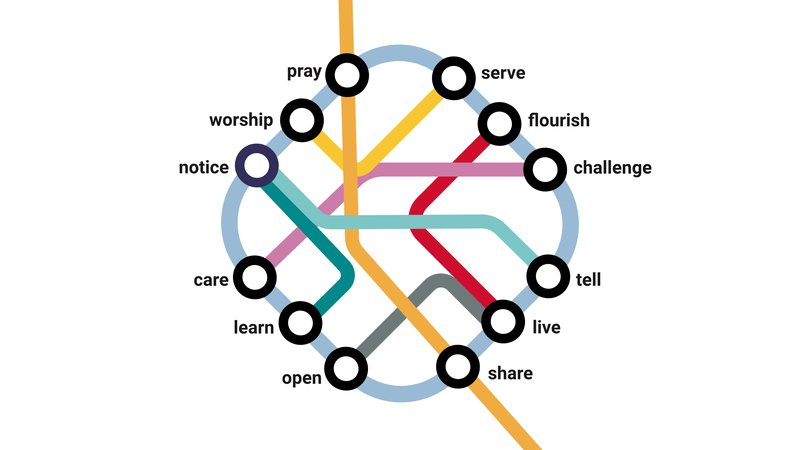
MWOL Train Map

In these pages we focus on three of these practices in more depth, and explain why they matter.

Worship

Worship is giving thanks and praise to God with joy. We celebrate who God is and what God has done, in the power of the Holy Spirit.

Worship happens in church services – formal or informal – but also in everyday life when we spend time with God or serve others in love.

The sacraments

Sacraments are special signs that show what God has done for the world through Jesus Christ.

One way of describing sacraments is to say that they are ‘outward and visible signs of an inward and spiritual grace’. They use physical signs like water, bread and wine, but what really matters is the grace of God that we encounter through them.

The Methodist Church recognises two sacraments: Baptism and the Lord’s Supper.

Baptism

Baptism shows God’s grace and forgiveness, and places us in God’s family. It may be given to infants, with faith to come later, or to young people and adults who already trust in Jesus.

The Lord’s Supper

The Lord’s Supper is also called Holy Communion or the Eucharist. In this meal, Jesus is present with his people. Together as God’s people, we give thanks over bread wine and pray that through the Holy Spirit they will be for us the body and blood of Christ. As we share the bread and wine, we remember Jesus’ death and resurrection, and give thanks. The Lord’s Supper recalls Jesus’ last meal with his friends, and gives us a taste of the feast to come in God’s kingdom.

Other elements of worship

Some of the things that shape Methodist worship include:

  • Hymns and songs –Methodists are known as a singing people. From Charles Wesley’s thousands of hymns – written hundreds of years ago when Methodism first began – to today’s wide range of music, singing helps us learn, pray and celebrate together.
  • Preaching and Scripture – The reading and preaching of the Bible is central. Methodists expect the Spirit to speak through the Bible.
  • Prayer – Methodist worship is soaked in prayer, from traditional written prayers to extempore (free) prayer, giving thanks, asking and listening to God.

Add links to the Resources Hub and the page on Singing the Faith above.

Styles of worship

Methodist worship today is very varied. Some churches have robed choirs, pipe organs, and formal liturgy (structured prayers and readings pre-written for group contexts). Others gather with guitars, drums, and a more relaxed style. Some worship is quiet and reflective; other services are lively and joyful. In every style, the purpose is the same: to give glory to God and to draw people into God’s presence.

The Covenant Service

Renewing our commitment

Each year Methodists gather for the Covenant Service. It is one of the most distinctive traditions in our Church. At its heart is the Covenant Prayer, in which we offer ourselves to God again, asking that our whole lives may be shaped by his love and will.

Where it began

John Wesley, founder of Methodism, introduced the Covenant Service in the 1700s to help people take their Christian life following God seriously. He wanted Methodists to renew their promises to God regularly, not just once in a lifetime. Since then, the service has become part of our annual rhythm - often held at the start of a new year.

The Covenant Prayer

The prayer is simple but challenging. We remind ourselves that our lives are not our own, but belong to God. We promise to be ready for whatever God asks –whether that is easy or hard, joyful or costly.

Contemporary version

I am no longer my own but yours.

Your will, not mine, be done in all things, wherever you may place me, in all that I do and in all that I may endure; when there is work for me and when there is none; when I am troubled and when I am at peace.

Your will be done when I am valued and when I am disregarded; when I find fulfilment and when it is lacking; when I have all things, and when I have nothing.

I willingly offer all I have and am to serve you, as and where you choose. Glorious and blessèd God, Father, Son and Holy Spirit, you are mine and I am yours.

May it be so for ever.

Let this covenant now made on earth be fulfilled in heaven.

Amen.

Traditional version

I am no longer my own but yours.

Put me to what you will, rank me with whom you will; put me to doing, put me to suffering; let me be employed for you or laid aside for you, exalted for you or brought low for you; let me be full, let me be empty, let me have all things, let me have nothing; I freely and wholeheartedly yield all things to your pleasure and disposal.

And now, glorious and blessèd God, Father, Son and Holy Spirit, you are mine and I am yours. So be it. And the covenant now made on earth, let it be ratified in heaven.

Amen.

In this traditional form, the words, “Put me to doing, put me to suffering”, have raised difficulties for some people. These words do not mean that we ask God to make us suffer, but rather that we desire, by God's help, actively to do or patiently to accept whatever is God's will for us.

A service of grace

The Covenant Service is not about trying harder to impress God. It ends with Holy Communion [LINK: Lord’s Supper], reminding us that we live by God’s grace [LINK: grace]. As we share bread and wine, we remember that God's love comes with no strings attached. The Covenant Prayer is our response to God’s grace: a willing "yes" to God's love and call. We pray that the Holy Spirit will continue to shape us in that love.

The Covenant Service helps us to pause, take stock, and renew our faith. It challenges us to live more fully for Christ, and reassures us that whatever lies ahead, God’s love will hold us.

Singing the Faith

Methodists are sometimes called “a singing people.” From the very beginning, hymns have been at the heart of our worship and our discipleship.

Charles Wesley, brother of John Wesley, wrote thousands of hymns that helped ordinary people learn and live the Christian faith. These hymns were like sermons in song – teaching theology, telling the story of Jesus, and shaping the lives of those who sang them.

Singing has always been important for Methodists because it involves the whole person: body, mind and spirit. When we sing, we remember and celebrate, we pray and proclaim, we grieve and we rejoice. Hymns carry the faith into our hearts and onto our lips.

Today, the official hymn book of the Methodist Church in Britain is called Singing the Faith. It brings together the best of the old and the new – Charles Wesley’s hymns alongside newer songs of worship, global voices, and songs that speak to the challenges of our world today.

Singing the Faith is more than a book: it’s a reminder that we keep learning, growing, and expressing our faith in song, together as a community.

For Methodists, singing is not just an extra to worship – it is one of the ways we sing our faith into being, joining with one another and with the whole Church through time and across the world.

Pray

Prayer is how we communicate with God. We pray because we trust God, want to follow God’s way, and depend on God for guidance, strength and comfort. Jesus prayed often and taught his followers to do the same.

There are many ways to pray, and it’s good to experiment to find a way that suits you. Praying doesn’t have to include words, it might involve artwork, meditation, or even crying or screaming! The main thing is to spend time with God, as you are, like you would spend time with a friend. This might be silent companionship, a good chat, or something physical or creative.

You should pray however feels natural to you, but it’s also good to try something different and see what happens.

What does prayer include?

There isn’t one set formula for prayer, it’s all about you and God. But some elements are often included:

  • Adoration – praising God for who God is.
  • Confession – telling God about the times we’ve messed up and seeking forgiveness.
  • Intercession – praying for other people we know, or for world events and strangers affected by them.
  • Petition – asking for our own needs.
  • Thanksgiving – giving thanks for God’s gifts.
  • Meditation – reflecting quietly and resting in God’s presence.

Does God hear our prayers?

God always hears our prayers. Answers may not come immediately or in the way we expect. Sometimes we do not recognise the answer, or God may use us to answer our own prayers or those of others.

Our small group course, Sunshine and Showers: Prayer’s Beautiful Messiness, explores this in more detail.

The Lord’s Prayer

Jesus gave us the prayer we call the Lord’s Prayer. It is both a prayer to use and a model for our own prayers. Some people say it regularly, others use it as a jumping off point to think about what the words mean for us, personally, in this moment.

Our Father in heaven, hallowed be your Name,
your kingdom come, your will be done,
on earth as in heaven.

Give us today our daily bread.
Forgive us our sins as we forgive those who sin against us.
Save us from the time of trial and deliver us from evil.

For the kingdom, the power, and the glory are yours,
now and for ever.

Amen.

Praying in the name of Christ

To pray in the name of Christ means to pray with his authority, as people whom God has saved and brought close through Jesus. It also means that what we ask for should be in line with Christ’s will – what Jesus himself would want for us. When we pray in his name, we trust that our requests are shaped by his love and purpose, and we submit them to that test.

For more information on praying visit the Prayer Hub.

Who knows / controls the future?

Methodists believe that God knows and loves us completely and the future is held in this knowledge and love, rather than being determined by luck, fate, or anything else. Alongside this, we also believe that humans have real freedom and responsibility over our lives (‘free will’) so our lives are affected by both our, and other people’s, choices. Some Methodists may enjoy horoscopes, seeing them as light entertainment, whereas others may avoid them, seeing them as not relying on God but something else.

Ideas, such as karma, manifesting, and destiny have different origins, but they all touch on the same theme: seeking meaning and understanding the consequences of our actions. Karma, for example, is a concept found in many Indian religions, such as Hinduism. It is about cause and effect, believing that someone’s intentions and actions (cause) will affect their future (effect).

A question we may ask ourselves is, “What are we relying on to guide our lives?”. For Christians, the best guidance is always found in Jesus. Christians have faith that following God’s desire for us and the world will lead to a better future. However, we don’t believe that bad things happen because someone has been ‘bad’ or good because they have been ‘good’. We are all in need of God’s love and God offers it to us all. Free will means that we have the choice to do good or bad.

While some Christians talk about ‘prophecy’, this must be treated careful. It could be that some people are very good at noticing patterns and can work things out intuitively, having a strong instinct or ‘premonition’ that something is wrong. The Bible does record accounts of future events being revealed to people and some Methodists testify to similar experiences. It’s important to discern what is being thought and felt, and what the ‘premonitions’ are about.

Methodists often see prophecy being less about the future and more about speaking truth to power. Prophetic words might encourage people, promote justice, or present warnings, but they always bring people closer to God’s love.

Our focus should be discerning what God is doing in the world and how we can join in with that.

Notice God in The Bible

The Bible is a collection of books in two parts: the Old Testament and the New Testament. These books were written over many centuries. They tell how God has acted among people and spoken to them and through them.

The writers used their own words, shaped by their language, culture and time in history. In different ways, they all shared their faith in God.

The Bible shows how God makes Godself known, most clearly in Jesus Christ. God still speaks through the Bible today, by the Holy Spirit. When we read the Bible, either on our own or discussing it with others, the Holy Spirit can reveal things to us about God, the world, and ourselves. It can teach us about God and inspire us to live God’s way.

Old Testament

The Old Testament is also called the Hebrew Scriptures: these writings are holy for Jewish people. It is the first part of the Christian Bible. It was written before Jesus was born and tells the story of God’s people over many centuries. It describes how God created the world, made promises, and called people to live in God’s way.

These writings reflect the beliefs and experiences of the people who recorded them, and include passages that Christians today wrestle with, including accounts of violence that are not understood as God’s will.

The Old Testament includes many kinds of writing:

  • Stories about people like Abraham, Ruth and David.
  • Laws that guided God’s people.
  • Songs, poetry and prayers, such as the Psalms.
  • Messages from prophets who spoke about God’s justice and hope.

These books tell how God cared for people and stayed faithful, even when they turned away. They show God’s love and promises and point forward to what God would do through Jesus.

Christians read the Old Testament because it helps us understand who God is and what God wants for the world. It is the Bible that Jesus and the first Christians knew. It teaches about God’s faithfulness and reminds us that God’s purpose is for all people to live in love and peace.

Reading the Old Testament also connects Christians with the faith, questions, and hopes of those who came before, whose traditions continue to shape how we live and believe today.

New Testament

The New Testament is the second part of the Bible. It was written after Jesus was born and tells the story of Jesus and the early Church. It shows how God’s promises in the Old Testament were fulfilled through Jesus Christ.

The New Testament includes different kinds of writing:

  • The Gospels – Matthew, Mark, Luke and John tell the story of Jesus’ life, teaching, death and resurrection.
  • Acts of the Apostles – tells how the first Christians shared the good news of Jesus, and how the Church began.
  • Letters – written by leaders like Paul to encourage, challenge and guide Christians.
  • Revelation – A book recounting a vision of the end of time. The meaning of the book is much debated.

Gospels

The Gospels are the first four books of the New Testament: Matthew, Mark, Luke and John. They tell the story of Jesus’ life, teaching, death and resurrection. Each Gospel gives a different view, but together they share the good news of God’s love in Jesus Christ.

The word Gospel means “good news.” The Gospels were written so that people could know Jesus and believe in him. They tell us what Jesus said and did, how he cared for people, and how he gave his life for the world.

The Gospels include:

  • Stories of Jesus’ birth and childhood
  • His teaching and miracles
  • Parables (short stories Jesus told to explain God’s kingdom and how we should live)
  • His death on the cross and rising to life again

The Gospels are at the heart of the Bible because they tell the story of Jesus, who is the centre of our faith.

Epistles

The epistles are letters found in the New Testament. Most were written by early Christian leaders, like Paul, Peter, James and John. These letters were sent to churches and individuals to teach, encourage and guide them in following Jesus.

The epistles include:

  • Advice for living as Christians
  • Encouragement to keep faith in hard times
  • Teaching about God’s love and grace
  • Practical guidance for church life and relationships.

The letters were written to real people in real places, but their message still speaks to us today. They help us understand what it means to live as God’s people and share God’s love in the world.

Who wrote the Bible?

The question of who wrote the Bible is not simple. Some people say, “God wrote it,” but even that can mean different things to different people. Here we are thinking about the human writers through whom the books of the Bible came into being.

Many different people were involved in writing the Bible. Some books name their authors and were written for a particular person or community. Others do not name a writer at all.

Scholars also ask whether a book was always written by the person it names. This is especially discussed with some New Testament letters. For example, some believe that the letters of Peter were written by a community of his followers after his death. They may have written in his name to pass on his teaching. This was not meant to be dishonest, but a way of keeping Peter’s message alive.

The books of the Bible were written in many different situations – times of persecution, war, slavery, monarchy, conflict and uncertainty. Even when these settings are not described directly, knowing the background helps us understand the feelings, ideas and viewpoints in the text.

We should also remember that writers never work alone. They are shaped by the ideas, stories and traditions around them. Sometimes they collect material that already existed. For example, the Gospel writers likely used both spoken stories and written accounts of Jesus’ life and ministry. Philippians 2:6–11 may even quote an early Christian hymn. Each part of the Bible belongs to a wider tradition or shared understanding of faith.

Different ways people approach the Bible 

People engage with the Bible in different ways, often holding several approaches together at the same time.

Many read it devotionally, seeking guidance, wisdom and a deeper relationship with God – sometimes described as reading it as “God’s supreme rule of faith and practice” for life. At the same time, readers may also pay attention to historical questions about who wrote particular books, when and why, to better understand their original setting and meaning.

Others look for deeper spiritual or symbolic meanings, reading the Bible allegorically or reflectively, while also being attentive to how its words speak into contemporary concerns. Many readers are shaped by social-justice perspectives, informed by liberation and feminist theology, which highlight God’s concern for those who are marginalised or oppressed.

These different layers of reading remind us that the Bible is both human and divine: written across many times, cultures, and perspectives, and yet trusted by Christians to speak today through the Holy Spirit. Holding these approaches together can help readers listen more carefully, hear more fully, and apply the Bible’s message thoughtfully in their own lives.

This paper gives a good overview of different lenses for reading the Bible.

There are lots of different Bible translations. There are also study Bibles, journal Bibles, youth Bibles, justice Bibles, and many other Bibles which take different approaches to suit different needs. It’s important to take some time choosing the right Bible for you and it can often be helpful to use more than one version.

The Methodist Church encourages the use of the NRSVA or NRSVue for accuracy and use of inclusive language.