Gathering at the University of York from 11th – 15th July, the debates were held in an atmosphere of prayer and a recognition of the hope that we all share in Christ.
The Synod began with the Presidential Address given by the Most Revd Stephen Cottrell, Archbishop of York. Drawing on the illustration of the waters of baptism, he reminded the Synod that Jesus calls his disciples to ‘put out into the deep’. Recognising that there is much to do in mission and ministry, he quoted Graham Greene, ‘If you’re going to jump, make sure the water is deep enough.’ He reminded us of our calling to engage in the evangelism and mission which is at the heart of drawing others to faith in Christ in order that they may join us in the waters of baptism.
Recognising the issues which present difficulties for the Church and those with differing views and opinions, Mr Cottrell reminded the Synod that it is the calling of the Church of England to be Christ centred, whether clergy or lay, and to teach, proclaim and defend the Christian narrative in an increasingly hostile world. With issues such as assisted dying, an eco-crisis and internal struggles as presented by Living in Love and Faith Mr Cottrell said we are called to hope in Christ.
Mr Cottrell concluded his address saying that the Church of England have been humbled in recent days. ‘We belong to each other and we must seek to be a simpler, humbler, bolder Church. We must show our lives to be centred in Jesus who said, ‘If you drink of this water you will live’ (John 4: 13).
Thus the tone for a reflective, prayerful Synod gathering was set.
Amid a packed agenda, much of which was to do with practicalities and procedures for the Church of England, the Synod addressed a number of significant issues of mission and ministry.
Reflecting on the outward facing ministry of Army Chaplains, the Synod agreed to support their ministry through amending canon law to specify that a priest, ‘in the minister’s capacity as Armed Forces chaplain, may offer the offices and services specified in the licence without any further authority from the bishop of the diocese in which those offices or services are performed.’ This significant amendment enables ministry across Diocesan boundaries without recourse to seeking permission from the relevant Diocesan Bishop.
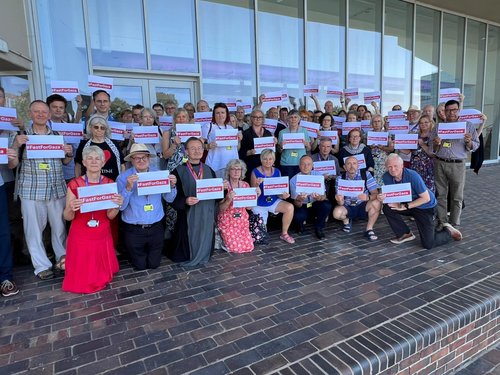
Synod members were invited to participate in a ‘red line and fast for Gaza’ on Saturday lunchtime, something in which I was privileged to participate as I had but days earlier at the Methodist Conference.
There was discussion and debate surrounding church growth and revitalisation; witness in rural areas and a recognition of 10 years of the Thy Kingdom Come initiative in which the Methodist Church are pleased to be partners.
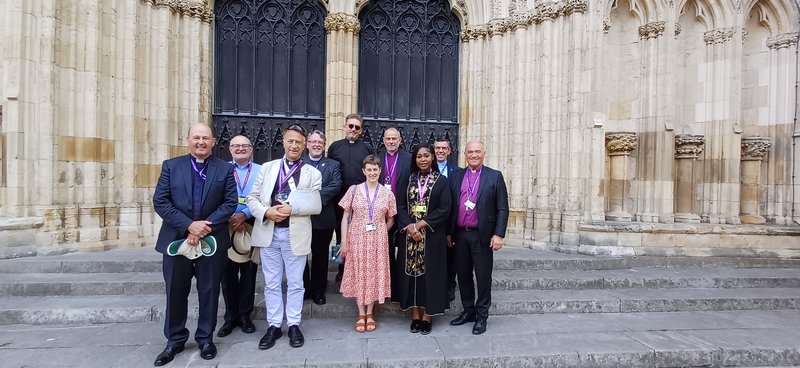
Sunday began with the Synod attending morning eucharist at York Minister. The preacher was the Most Reverend Andrew Chan, Archbishop and Primate of Hong Kong Sheng Kung Hui, a guest of the Synod. He took as his text, Luke 10: 25 – 27 and gave a masterful reflection on what it means to be the Samaritan who challenges the regular narrative regarding the needy by the many who say, ‘it’s not my problem’. Mr Chan offered a clear challenge to the gathered congregation that we are all to be the Samaritan in our suffering and struggling world which needs good Samaritans more than ever. ‘It IS our problem, yours and mine.’
Andy Fyall
Following a challenging and inspiring act of worship, we returned to the business of the Synod. The Synod were reminded of the cost of discipleship during liturgical business. Ten years ago, on 15 February 2015, twenty one Christian men of the Coptic Orthodox Church were martyred by militants of the terrorist organisation Daesh, the so-called ‘Islamic State’, on a beach near Sirte, Libya. This tragic event, documented and broadcast on social media by the perpetrators, has been widely recognised as a profound witness to the Christian faith. These martyrs, who were mainly migrant labourers from Egypt, refused to renounce Christ despite the threat of death, affirming their faith with the supplication ‘O my Lord Jesus’ as they met their end. Following compassionate and moving speeches from members of the Synod, including His Eminence Archbishop Angaelos of the Coptic Orthodox Church, it was agreed that the 21 Martyrs of Libya should be added to the liturgical calendar. The Synod held a moment of corporate prayerful silence in agreeing the motion.
Much of Monday’s business was taken up with the Synod reflecting on the Abuse Redress Measure and how the Church of England will offer appropriate reparations to survivors of abuse. As an ecumenical member of the Synod, it was a privilege to sit prayerfully among our Covenant partners as they held an honest and real conversation about past failures and worked towards a better and safer future for all. I sat among a Church recognising it’s need for a careful, repentant and clear response to survivors of abuse; a Church seeking to learn from past failures in order to become a safer Church rooted in integrity and hope. As one contributor said, ‘What has been cannot be undone but learning can enable a better future given that the scars of the past will remain.
The Synod agreed to the Abuse Redress Measure in full and by a unanimous vote following.
Andy Fyall
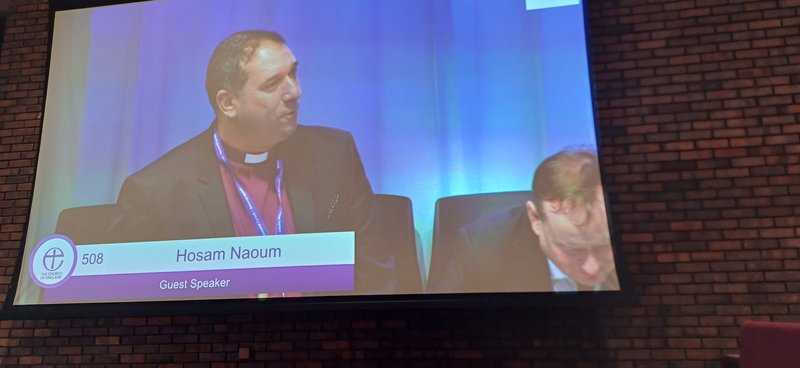
The Synod’s final session on Tuesday morning began with an address given by the Most Reverend Hosam Naoum. The Archbishop had travelled from Jerusalem in war torn Israel to be present in person at the Synod. In approaching the tribune, Archbishop Hosam was greeted by a lengthy standing ovation and applause. He spoke movingly of his ministry in the Diocese of Jerusalem and what it means to be Church in a time of war. Whilst experiencing cruel and unwarranted loss of life, he spoke of being a presence of hope in despair. ‘We are battered and bruised but not defeated or crushed’, he said. ‘we are committed to peace building and reconciliation following our Lord’s teaching and message of love. The Church offers a ministry of presence and resilience; it is there to be the source of hope for all. We are not politicians but prophets speaking out for hope, peace and justice.’
In concluding, Archbishop Hosam quoted the words of Jesus, ‘from my home place, Nazareth’.
‘“The Spirit of the Lord is on me, because he has anointed me to proclaim good news to the poor.
He has sent me to proclaim freedom for the prisoners and recovery of sight for the blind,
to set the oppressed free, to proclaim the year of the Lord’s favour.”
The chamber resounded with applause during another standing ovation as the Archbishop of York approached the tribune, greeted the Archbishop of Jerusalem in an embrace and then offered prayer for Gaza and Palestine and the Church in that place.
Business followed during which there was a significant debate addressing the Church’s Vocations processes and enabling everyone to be treated equally in discerning their call whether male, female, LGBT+ or whoever. The Synod unanimously agreed the motion having heard speeches from members from varied backgrounds. This was a very significant moment in the Church of England’s journey towards fuller inclusivity.
The Synod concluded by agreeing a motion in the name of the Rt Revd Dame Sarah Mullaly, Bishop of London, unanimously affirming ‘that this Synod, in light of recent debates on the Terminally Ill Adults (End of Life) Bill, reaffirm that every person is of immeasurable and irreducible value, and request His Majesty’s Government work to improve funding and access to desperately needed palliative care services instead of enacting a law that puts the most vulnerable at risk.’
The care and support offered to the ecumenical members of the synod could not have been more genuine expressed especially through by the Revds Jeremy Morris (at his last General Synod before he retires in August) and Tim Norwood, the Church of England’s ecumenical officers.
It was my privilege to sit prayerfully among fellow disciples in a church who are seeking to learn from past experience and become a safer place for all. I once again heard their desire for God’s will to be known to all and it is my privilege to share in their journey on behalf of the Methodist Church of Great Britain.
I invite you to share in their journey with me prayerfully and caringly as the journey of the Church of England continues.
If called, the General Synod next gathers from 17th – 19th November and the next diarised meeting will be at Church House, London, in February 2026.
Revd Andy Fyall
Chair of the Nottingham & Derby Methodist District
Methodist Church Representative to the General Synod of the Church of England