We are in the unique position to knit together the Church's people, data and resources into a secure digital ecosystem that makes the Church more efficient, effective and safer, whilst directly advancing the vision to be a growing, inclusive, evangelistic and justice-seeking Church.
Why this matters
Digital transformation is more than adopting new systems. It’s about rethinking how the Church works - how ministers, volunteers, circuits and the Connexion collaborate; how we steward data and deploy resources; how we support mission and ministry in a changing world.
Our ambition is that by moving to a digital-first mindset we will:
- Free up time so ministers and volunteers spend more time in mission and less in administrative burden.
- Provide better-joined up, person-centred services across the Connexion.
- Strengthen data-informed decision-making, enabling us to respond more quickly and effectively to opportunities and risks.
- Ensure the Church’s systems are robust, secure and sustainable for the long term.
Our Vision and Aims
Vision
A Church where digital tools and processes help us live out Our Calling through connecting people, enabling ministry, supporting growth, and driving justice.
Aims
- Seamless digital experience for ministers, church officers, volunteers and members.
- Secure, well-governed data that supports transparency, accountability and insight.
- Reduced duplication and manual overhead across structures.
- Enabled mission and ministry: more time for people, less time on process.
- Scalable, flexible platforms that adapt as the Church evolves.
Our Principles
Our approach to transformation will be guided by key principles. These will underpin how we design services, select technology and work with people across the Connexion:
- People-centred – We put ministers, church officers, volunteers and members at the heart of everything we do.
- Bold and open to change – We embrace innovation, learn from what doesn’t work and iterate.
- Digital-first, accessible and responsive – We design services for the devices people actually use; we ensure accessibility for all.
- Data-driven – We capture, analyse and use data and insight, in an ethical way, to inform decisions and deliver better outcomes.
- Test, learn and improve – We build in measurement, feedback loops and continuous improvement.
- Collaborative – We work across the Connexion, engaging churches, circuits, district sand partners.
- Safe and secure – We protect personal data, comply with regulation and adopt high standards of cyber-security.
- Flexible, sustainable and interoperable – We build our systems to adapt, to reuse components and to integrate.
What we’re doing
The Programme consists of a number of inter-linked workstreams. Together, these will deliver the new systems, capabilities and ways of working that will underpin the Church’s digital future.
These workstreams will be identified through a Connexion-wide discovery exercise, as we understand the issues facing local people in their mission and ministry.
For each workstream we will be open and transparent about objectives and outcomes.
How it affects people
This transformation is about people first and technology second.
- For ministers and paid staff – you will have fewer manual tasks, better integrated systems, and clearer reporting/insight.
- For volunteers and church officers – you will have simpler, more accessible digital tools; less duplication; more time for your ministry and mission.
- For churches, circuits and districts – you will benefit from shared platforms, reduced local IT burden, better data-sharing and insight, and higher resilience.
We will provide training, support and resources so everyone can engage confidently with the new tools.
Listen to our podcast
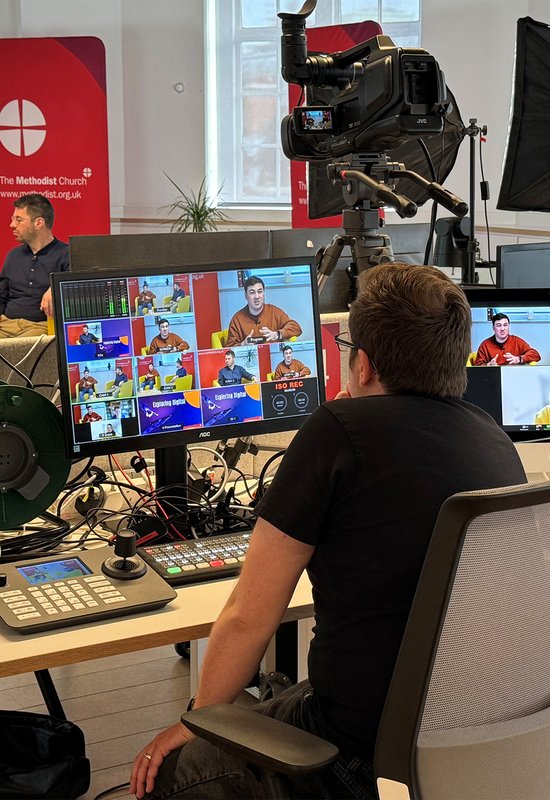
We're releasing regular episodes giving updates on the Digital Transformation Programme, so it's easy to stay up to date with the progress.

Governance, roles and responsibilities
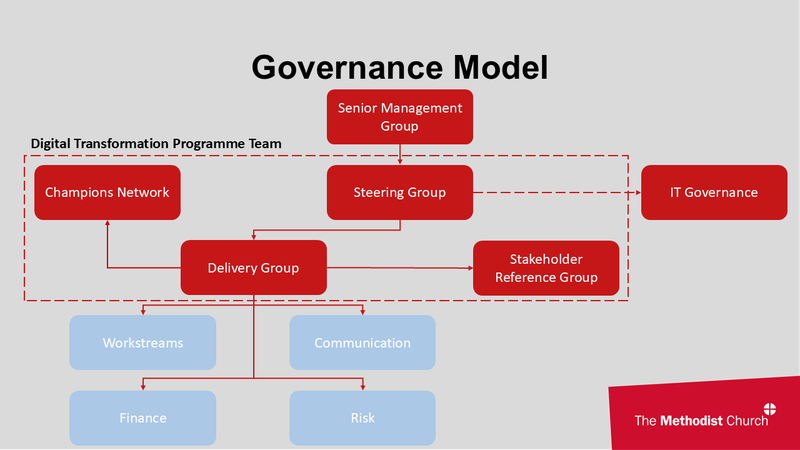
The Programme is overseen by a Steering Group, chaired by the Director of Digital and Transformation. This Group will provide approvals at the end of each phase of work, ensuring objectives are met. A Delivery Group will manage the day-to-day work that comes out of the discovery exercise. A Stakeholder Reference Group will provide an opportunity for roles across the Methodist Church to feedback and ensure solutions work in real-life context.
A core team of specialist roles will be recruited, working alongside trusted suppliers and existing roles. A Connexion‑wide Champions Network will support adoption on the ground.
Key governance bodies
- Steering Group – provides strategic oversight and approves business cases
- Delivery Group – drives delivery and coordinates across workstreams
- Stakeholder Reference Group – gives insight and user-centred feedback to support adoption
- Champions Network – circuit and district-based people who support roll-out and help embed change locally
We will ensure transparency, accountability and regular reporting to the Connexional Leadership and wider church.
Steering Group membership
- Ben Hollebon - Director of Digital and Transformation (Chair)
- Doug Godfrey-Swanney - Connexional Secretary
- Andy Webb - Director of IT
- Jane Bates - Senior Governance Executive Officer
Stakeholder Reference Group membership
- Ben Hollebon - Director of Digital and Transformation (Chair)
Currently recruiting.
Champions Network membership
- Ben Hollebon - Director of Digital and Transformation (Chair)
Currently recruiting.
Frequently Asked Questions
What is digital transformation and why is it necessary for us?
Digital transformation means how we use technology, data and new ways of working across our organisation to better support mission, ministry and growth. It is necessary because the context in which the Church operates is changing: expectations of digital services are higher, data and governance requirements are stronger, and the potential for ministry is amplified by better tools.
How does digital transformation differ from digitisation?
Digitisation is about converting analogue tasks into digital ones (for example moving a paper form online). Digital transformation goes further: it re-thinks how services are delivered, how people work, how decisions are made and how the organisation evolves.
How will the programme align with our mission and values?
The programme supports our mission to be a growing, inclusive, evangelistic and justice-seeking Church. It is not simply a back-office upgrade: it is a way of better serving our communities, improving stewardship, and enabling mission.
Who is leading the digital transformation programme?
Ben Hollebon is Director of Digital and Transformation and leads the Programme.
What about change and culture?
Change is often harder than just implementing new technology. We are investing in training, support (digital champions, peer networks, etc.), communication and engagement across all levels of the Church.
How will data be managed and protected?
We are adopting clear data-governance, working with the relevant departments to ensure compliance (GDPR, safeguarding, charity regulation), building secure systems, and enabling the Church to be confident in its data stewardship.
How will success be measured?
We will use a balanced set of metrics: adoption and usage of new systems, satisfaction rates among ministers/volunteers, reduction in manual tasks, improved data quality and insight, cost-savings, time-reallocated to mission, etc.
How is this programme funded?
The programme is funding through the Connexional Priority Fund, supported by the Connexional Council.
How will we communicate progress and celebrate successes?
Regular updates will be published via the Methodist News and on our website. Case-studies and user stories will highlight how the change is making a difference.

Digital Transformation Programme announced
A bold and forward-looking initiative that will support the Church in becoming more connected, responsive, and equipped for mission and ministry in a digital age.