Digital Transformation Programme
The Methodist Church is bringing its people, data and tools together into a safe, joined-up digital eco system. The aim is simple: free up time for ministry, make life easier for volunteers, and help every part of the Church share what it knows.
Why this matters
Digital transformation isn't really about new systems. It's about rethinking how the Church works together — how ministers, volunteers, circuits and the Connexion share information, look after data, and support mission and ministry.
We want to:
- Free up time, so ministers and volunteers can spend more of it on mission and less on admin.
- Make services join up better, so people don't have to keep repeating themselves.
- Use data better — and ethically — to spot opportunities and risks sooner.
- Make sure the Church's digital tools are safe, reliable and built to last.
Our Vision and Aims
A Church where digital tools help us live out Our Calling — connecting people, enabling ministry, supporting growth, and seeking justice.
What we're aiming for:
- Digital tools that feel the same wherever you use them, whether you're a minister, a church officer, a volunteer or a member.
- Data that's safe, well looked after, and tells us what we need to know.
- Less duplication — fewer times you fill in the same form twice.
- More time for people, less time on process.
- Tools that grow and change with the Church.
How we work
Eight principles guide how we design, choose tools and work with people across the Connexion:
- People first — We start with the people using the tools: ministers, church officers, volunteers and members.
- Open to change — We try things, learn from what doesn't work, and try again.
- Designed for the devices people use — We build for phones and laptops alike. Everyone can use what we make.
- Honest with data — We use data — carefully and ethically — to make better decisions.
- Test, learn, improve — We measure what we're doing, ask people what they think, and keep getting better.
- Working together — We work across the Connexion with churches, circuits, districts and trusted partners.
- Safe — We protect personal data, follow the rules, and take cyber-security seriously.
- Built to last and to fit together — We make systems that adapt over time and work alongside what already exists.
What we’re doing
The programme is made up of several connected projects, called workstreams. Together, they'll deliver the new systems and ways of working the Church needs.
We're working out what each workstream should focus on by listening — across every district, circuit and church. People doing the work tell us what's hardest, and that shapes what we build.
For every workstream, you'll know what we're trying to do, how we're doing, and what comes next.
What this means for you
People first, technology second.
We'll provide training, support and resources so everyone can use the new tools confidently — including those who haven't done much with digital tools before.
- If you're a minister or paid member of staff — fewer manual tasks, systems that talk to each other, and clearer reporting.
- If you're a volunteer or church officer — simpler tools, less duplication, and more time for the ministry and mission you came to do.
- If you're a church, circuit or district — shared platforms, less local IT burden, easier data-sharing, and more resilience.
Connected — our podcast
Connected is a short, semi-regular podcast (around 15 minutes) about the Digital Transformation Programme. Each episode shares what we've learned, what's coming next, and the questions we're still working on. Listen on your phone, in the car, or wherever podcasts live for you.

Discovery report now live
The master discovery report is now live - detailing everything we heard during three months of listening across the Connexion.

Governance, roles and responsibilities
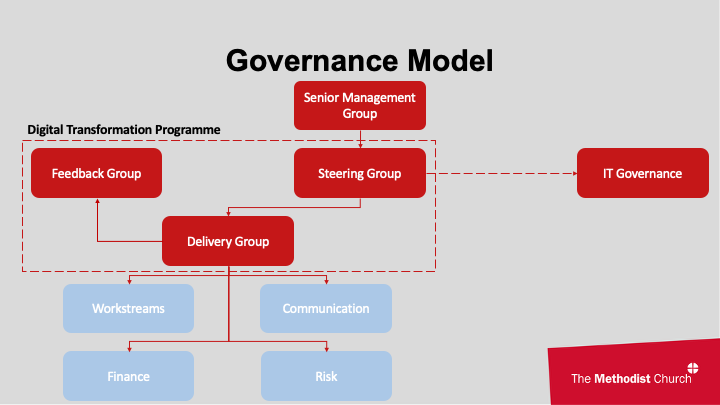
The Programme is overseen by a Steering Group, chaired by the Director of Digital and Transformation. This Group will provide approvals at the end of each phase of work, ensuring objectives are met. A Delivery Group will manage the day-to-day work that comes out of the discovery exercise. A Connexion‑wide Feedback Group will provide insight and feedback on solutions we propose to ensure they match the need on the ground.
Key governance bodies
- Steering Group – provides strategic oversight and approves business cases
- Delivery Group – drives delivery and coordinates across workstreams
- Feedback Group – gives insight and user-centred feedback to support adoption. Join the Feedback Group.
We will ensure transparency, accountability and regular reporting to the Connexional Leadership and wider church.
Steering Group membership
- Ben Hollebon - Director of Digital and Transformation (Chair)
- Doug Godfrey-Swanney - Connexional Secretary
- Andy Webb - Director of IT
- Jane Bates - Senior Governance Executive Officer
Delivery Group membership
- Ben Hollebon - Director of Digital and Transformation (Co-Chair)
- Andy Webb - Director of IT (Co-Chair)
- IT Security Lead
- Product and Applications Manager
- IT Infrasturcture Manager
- Church Data Relationship Officer
- Senior Executive Officer
- Digital Engagement Manager
Frequently Asked Questions
Q1 — What is digital transformation and why is it necessary for us?
Digital transformation is about using technology and data, alongside new ways of working, to help the Church do mission and ministry better. The world the Church works in is changing — people expect more from digital services, rules around data have got stricter, and good tools can help ministry go further than ever.
Q2 — How does digital transformation differ from digitisation?
Digitisation is about turning paper tasks into digital ones — putting a form online, for example. Digital transformation goes further. It asks bigger questions: how should we deliver services? How should people work? How should we make decisions? How should the Church change over time?
Q3 — How will the programme align with our mission and values?
The programme is here to help us live out Our Calling — to be a Church that's growing, inclusive, evangelistic and seeking justice. It's not a back-office upgrade. It's a way to serve our communities better, look after what we've been given, and help mission flourish.
Q4 — Who is leading the digital transformation programme?
Ben Hollebon is the Director of Digital and Transformation. He leads the programme, supported by the Connexional Team and a Steering Group, Delivery Group, Stakeholder Reference Group and Champions Network. You can read about all four groups in the Governance section above.
Q5 — What about change and culture?
Changing how people work is often harder than putting new technology in place. So we're investing in training, support and communication at every level of the Church — including a Champions Network of people on the ground in circuits and districts who help others get to grips with new tools.
Q6 — How will data be managed and protected?
We're putting clear rules in place for how data is used and looked after. We work with the relevant teams to make sure we meet our legal duties — GDPR, safeguarding, charity regulation — and we build secure systems. The aim is a Church that can be confident its data is in safe hands.
Q7 — How will success be measured?
We'll measure a range of things: how many people are using the new tools, how satisfied ministers and volunteers are, how much manual work has been cut, how much data quality has improved, what we're saving, and — most importantly — how much more time people have for mission.
Q8 — How is this programme funded?
The programme is funded through the Connexional Priority Fund, with the backing of the Connexional Council.
Q9 — How will we communicate progress and celebrate successes?
Look out for regular updates in the Methodist News and on this website. We'll share case studies and stories from real ministers, volunteers and churches — so you can see what's working in practice, not just what we're planning.