Read reflections from our 2025 YAPP participant, Liddy.
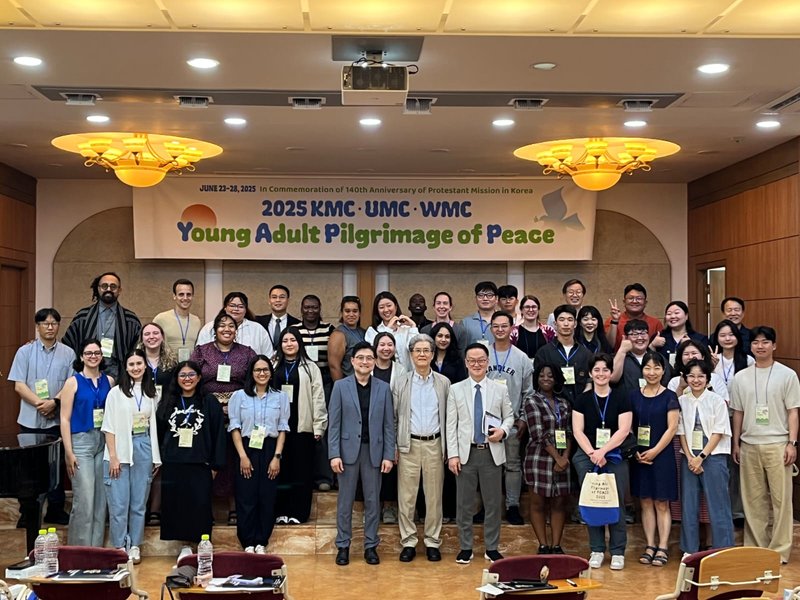
In 2025 I took part in a Methodist peace studies programme in South Korea. The application process was fast, and I didn’t have much time to envisage what I was getting into – but it turned out to be five glorious, colourful, diverse, moving and uncomfortable days. It was deeply challenging and devastatingly beautiful.
As this programme was billed as a “pilgrimage”, we moved about a lot, with every single day taking us to a new location: Seoul, Gwangju, Daejon, Paju and the DMZ, and back to Seoul.
Our first two visits were Korean war graves, in Gwangju and Daejon. These two places couldn’t have been further from each other: one was a purpose-built peace park with an enormous marble tower, neatly manicured tombstones, and a swish museum. The other was bleak scrubland, with a simple hut in place of a visitor centre, and victims' names scrawled on pieces of wood in place of tomb stones.
We were placed in discussion groups for the programme, and had raw and profound conversations as we wrestled with the sites of violence we'd visited. I remember Katie, an American minister asking “Where do you think Christ would have been in this situation?”. I think in 1980s Korea he would have been doing exactly what he was doing in Jerusalem in the first century: standing up for the marginalised, and being killed by state violence as a result. I also remember that Jiwon, a Korean theology student, turned to me and said “can we hug?” before proceeding to sob into my shoulder. Two girls in their twenties, from opposite sides of the planet, with barely any language in common, and yet united by a Methodist faith.
We also visited the DMZ, a 4km strip of land between North and South Korea. We were shown various points of interest, including the observation deck, where you can see into North Korea. Our government-appointed tour guide stressed that the village we could see was not a real place where people lived, but merely built as propaganda. At that point, George, an American seminarian, whispered “you mean to tell me we’re not standing in the same thing right now?”
After our visit, we had a lecture from a guy who lived in a village inside the DMZ. He described working on his farm, and seeing the North Koreans across the river working on their farms too. “We’re not all that different” he said. It was a real reminder that Christ’s love knows no boundaries.
I know I’m going to look back at this trip as a really important time in my faith journey. Most importantly, it gave me an embodied understanding that peace is not at all straightforward: peace building is messy, complex, uncomfortable, but so worth it. It was also a reminder that Christ is my anchor as I navigate a period of major change in my life. Shortly after I got home, I was let go from my job at Christian CND. I’m now working at Shieldfield Art Works – a Methodist run community art gallery in Newcastle. While it’s not formal activism, I can see echoes of the peace I found in Korea in our work building community and getting people to think deeply and creatively.
Additionally, my church has been in the early stages of planting a New Place for New People, for the past few years. This trip has shown me the importance of casual, loving community and meeting people where they’re at, and so it led me to listen to God’s call: I’m leaving my church to go all in on this new community. I’m excited about all this decision will bring, and I never would have come to it without taking part in YAPP.
The Korean War is still legally ongoing, as there was never a peace agreement, though there is no armed combat. While the hope of reunification is alive and kicking in South Korea, there is a whole spread of views on it. Many older people have family on the other side of the border, while many younger people are wary of the effect reunification with a country with a significantly lower GDP would have on their standard of living, having
seen what happened in Germany. There is also the idea that North Korea should be forced to conform to South Korean culture and ideals, rather than reunification creating a middle ground. I would encourage Methodists to pray for peace in the Korean peninsula, rather than reunification. I would also like churches to think deeply about how they discuss war and peace.
Liddy has been sharing in-depth reflections about peace at different Methodist churches, meetings and events – if you would be interested in booking Liddy to speak, please contact Vicky in the Global Relationships team: roylev@methodistchurch.org.uk