Contents
Welcoming people
The moment of entry and people’s first interactions at an event are key for making people feel comfortable and welcomed.
Try to ensure you are both a welcoming space and a welcoming people.
A welcoming space
- Is it obvious where people are supposed to go? Are any signs or stewards required?
- Could you play some music to create the kind of atmosphere you want?
- Decoration/atmosphere – make the space look inviting and organised.
- Food/drink – give attendees something on arrival that makes them feel welcomed and immediately gives them something to do beyond standing awkwardly.
How to welcome people
- Ensure everyone who arrives gets a warm personal welcome. You might want to have designated welcomers for this.
- Introduce people to each other – once you have welcomed someone, don’t just leave them to their own devices, connect them with another guest.
- Set expectations – explain both what to expect and, crucially, why you are hosting the event early on (and in your advertising). Don’t shy away from the fact you are a church and that you might want to have meaningful conversations about life and faith off the back of a shared experience. People are usually more open to talking about faith than you might think, but they are more likely to be receptive if they know from the off that might be on the cards, rather than feeling tricked into it.
Linking the eclipse with faith
The experience of the eclipse offers a few routes in to talking about faith – people are probably more open to this than you might think so don’t be shy!
These are some possible ways of linking the eclipse with faith that might be useful to have in people’s minds as they have conversations, and/or to form the basis of a short, reflection/homily that someone from the church might give.
Option 1 – The importance of awe, wonder and transcendence
- Research attests to the psychological and wellbeing benefits of having transcendence in our lives – connecting with something beyond ourselves makes us more compassionate, resilient and social.
- For Christians, we see awe and wonder as one of the ways God reveals Godself to us and allows us to connect with the divine.
- This connection is one aspect of a deeper relationship. A relationship that is available to all.
Possible discussion question: Do you feel part of something bigger when you see something awe-inducing?
Helpful Bible verse: “When I look at your heavens, the work of your fingers, the moon and the stars that you have established; what are humans that you are mindful of them, mortals that you care for them?” (Psalm 8:3–4)
Option 2 – Present uncertainty and future hope
- Though the eclipse is beautiful, it is also unsettling. Temperatures drop, animals become disturbed and confused, the sun and things around us are obscured.
- Often, we find ourselves in periods of great confusion and uncertainty. The eclipse can be a hopeful image for all of us of darkness lasting only a moment, before being bathed again in the full warmth of the sun.
- As Christians, our confidence and hope for the future is rooted in what we believe Jesus has already achieved through his death and resurrection.
Possible discussion question: Can you think of a time when life felt confusing or unsettling, but clarity eventually returned? What helped you through it?
Helpful Bible verse: “The light shines in the darkness, and the darkness has not overcome it.” (John 1:5)
Option 3 – Comfort of celestial rhythms
- Though the earth is orbiting the sun at over 100,000 kph and the moon is orbiting the earth at over 3,000 kph, scientists can calculate to the minute when eclipses are going to occur centuries into the future.
- Many find it comforting, in a world full of chaos and uncertainty, that when we zoom out some things are still predictable and certain.
- For Christians, though we live during much uncertainty, we find hope in a God who is faithful, constant and who holds creation in order and purpose.
Possible discussion question: How does considering the predictability of some things in the universe make you feel?
Helpful Bible verse: “... all things have been created through him and for him… and in him all things hold together.” (Colossians 1:16–17)
Example reflection
You may want to use or adapt this short meditation written by Assistant Secretary of the Conference Revd Michaela Youngson:
There is a pattern in the way that planets move,
the heavens are governed by laws and physics.
We can count on the sun rising, the moon waxing and waning,
the stars shining and comets marking their course.
There is reassurance in the ordering of the universe,
yet still we look on in wonder.
The prophets and wise travellers have for millennia
sought direction from the stars.
Poets continue to wax lyrical about starlight
and celestial symmetry paints constellations
in which we mere human beings
find or seek meaning beyond science.
The reliability (at least for a few more million years),
of the ordered heavens,
sits in sharp contrast to the chaos of earthly
conflict, climate crisis and profound inequality.
This eclipse reminds us of the reliability of God,
reassures us that light will follow darkness and,
even when it seems not to, God sees, knows and loves
all people, even us, just as we are in all our chaos.
Having meaningful conversations
While you might do a little bit of communication from the ‘front’, the best way to build relationships and share faith is normally through conversation.
We certainly do not want to force people into conversations they do not want to have – if you sense resistance or discomfort, then do not force the issue. There is no pressure or expectation on any given conversation – we trust that God is reaching out to people independently of anything we might say or do.
But if we do not try to get beyond the small talk, we often don’t even give ourselves the chance of having conversations about faith with people who might be open or even searching for them.
Try and encourage everyone from your church to have one conversation just outside their comfort zone – to ask one probing question, to listen deeply, and to be slightly more intentional and open about the role of faith in their life.
Some key principles and possible conversation starters are listed below – it might be useful to go over these with your volunteers ahead of the event and think of some questions of your own.
You might want to order for your event some packs of Conversations Against Mundanity, a game produced by the Methodist Church in Britain to help prompt deeper conversations in a fun way. These could be placed on tables or picnic blankets and lightly facilitated by someone from the church.
Principles for meaningful conversations
- Be Attentive – listen actively, with your eyes and body language as well as your ears, and be sensitive to what’s going on (including being attentive to God).
- Be Brave – don’t be afraid to be vulnerable and share why your faith makes a difference to you.
- Be Calm – don’t rush it. Pauses in conversation are healthy, and don’t be pushy, don’t judge or react negatively, show compassion.
- Be Dependable – take care of others and yourself (think of wellbeing and safeguarding) and be responsible for your own triggers. Remove yourself from a conversation if you need to.
- Be Enquiring – model curiosity, ask good questions and follow the thread of meaning in a conversation.
Examples of good questions to ask in conversation
- If you could witness any natural phenomenon up close, what would it be?
- Does looking into space make you feel connected to something bigger than yourself?
- What made you want to come out and view the eclipse with others instead of alone?
- What’s your most treasured memory of experiencing the natural world?
- How interested are you in astrophysics/astronomy? Why/why not?
- When else do you experience awe and wonder? How important is that for you?
- How often do you get the chance to have a meaningful shared experience with others?
Good ways of framing deeper questions
- “I’m curious…”
- “No pressure to share, but I wonder…”
- “I hope you don’t mind if I ask a slightly deeper question…”
- “No wrong answer…”
- “I’d love to learn about your experience, can I ask…”
Engaging people
While some food, a chance to wonder at the peak of the eclipse, and some friendly, intentionally conversationalists will go a long way to a successful event, you may want some additional activities and ways to engage to fill the 1.5–2 hours you might gather for.
Below are some suggestions. You might want to put on some activities purely for entertainment value, but these all involve an element of reflection/conversation as well.
Lawn games with questions
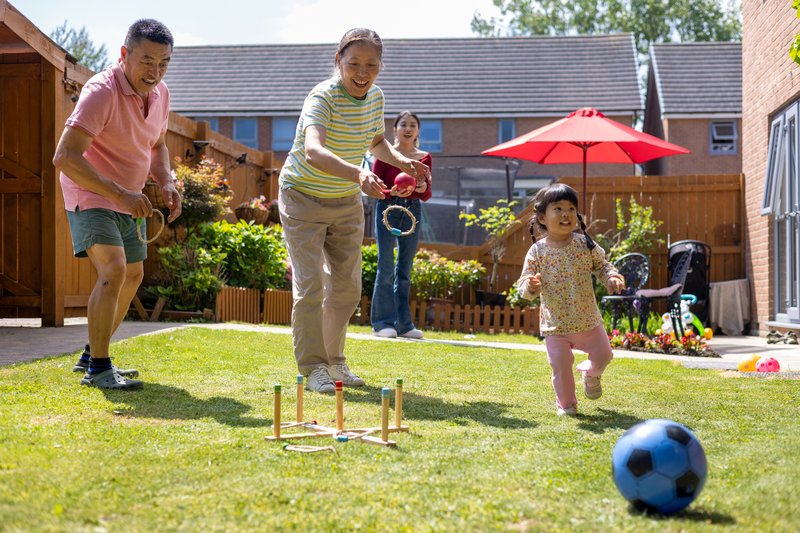
Source a set of giant Jenga, hoopla or similar and incorporate some questions for discussion into the game (eg by writing questions on Jenga blocks). Have a mixture of light-hearted and deeper questions.

Chalkboard/A-frame
Write one question (eg “When was the last time you were lost in wonder?”) on something big and invite attendees to add their answers, gradually building a tapestry of interesting responses, and inviting meaningful conversations while people ponder and write their answers.
Conversation sofa
Similarly to the above, as well as having good chats while milling around, you could have a space that is specially designated for deeper conversation (it doesn’t have to be a sofa!). It is useful to have a particular starter question, and a rotation of volunteers taking up one spot on the sofa. You might be surprised by how many people want a go!


Craft corner
There are plenty of ideas for eclipse-related craft activities online where a conversational element could be incorporated, eg making some pinhole viewing boxes at the beginning of the event, ready for use later on.
Science area
If you have a confident science communicator among your team, why not have an area where people can learn more about eclipses or interesting astrophysics generally?

Prayer tree
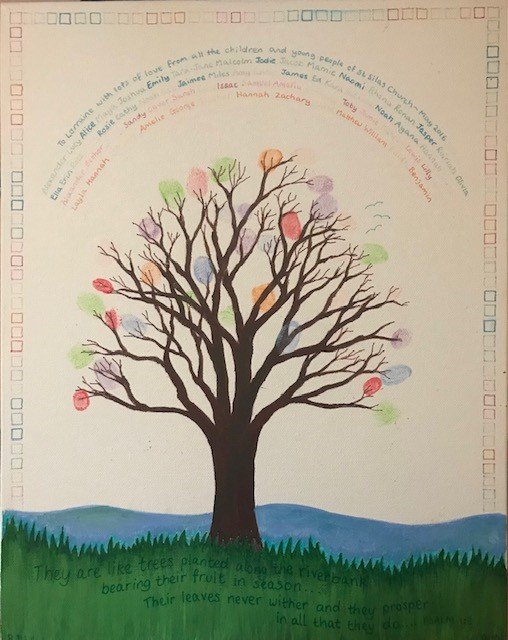
Invite people to write down situations where they would welcome prayer and assure them that the church community will pray for them.
Specially produced content
Some ready-to-use pieces of content are available for you to use in and around your events, including:
- Day of Outreach activities – a range of flexible, ready-to-use outreach activities for families and people of all ages. These activities help participants explore the eclipse, discover the wonder of God's creation, and reflect on themes of awe, faith and the world around them (available here).
- Eclipse-themed worship resource – eclipse-themed prayers, readings and hymn suggestions by Assistant Secretary of the Conference, the Revd Michaela Youngson (available on this page).
- A powerful spoken word piece inviting us to reflect on what the eclipse might teach us about awe and wonder, science and faith, is available to download either in video or audio. We encourage you to play this at your eclipse events where possible.
- A conversation featuring the Revd Prof David Wilkinson and Stephanie Bevan – two excellent science and faith communicators – is also available to download. This explores why the eclipse is fascinating scientifically, as well as how and why scientific inquiry and appreciation of the universe can sit alongside, and even enhance, faith. This is a little longer, so may be better suited for use in advertising or in worship services/small groups.
- An accessible reflection written by the Revd Michaela Youngson, Assistant Secretary of the Conference, to help lead people into a place of transcendence and awe.
Free-to-use Poem
Christine Woolgar, a Methodist Local Preacher, has written a beautiful poem The Two Great Lights to celebrate the eclipse. She has also turned it into a flyer with short explanations about the poem and the Christian faith. Churches are welcome to download this and use the blank space on the back to advertise their church or other information, such as details of a watch party.
Print it landscape, double-sided (flipping along short edge). Then fold it twice: with the poem side facing upwards, fold in the right third (there is a little grey mark to help you fold it to the right place) and then fold in the left third. Once done, the front should be “A poem to celebrate the solar eclipse”.
Example running order
17:00 | Team gathers to set up and pray.
18:00 | Welcome people as they arrive, introduce them to others, hand out eclipse glasses and food/drink.
18:05 | Offer a formal welcome to everyone, explain why you are holding the event and what people can expect.
18:30 | Play the audio of two scientists discussing the eclipse and the relationship of science and faith. Encourage people to talk about what they think.
19:00 | Play or read the reflection written for the Day of Outreach as the eclipse reaches its peak.
19:30 | Short talk/homily that gently shares something of the good news of Jesus.
20:00 | Offer a formal farewell, being sure to signpost to another church event/making clear how people can stay in touch or go deeper.
Throughout – Intentional, friendly, curious conversations, any activities you have prepared, and leaving space to simply (and safely) admire the eclipse.
Explore the outreach activities...
-

Day of Outreach – All-age Conversation
An engaging five-minute outreach talk explaining solar and lunar eclipses using simple objects and audience participation.
Read more -

Day of Outreach – All-age Guided Awe Moments
A mix of awe moments to inspire everyone.
Read more -

Day of Outreach – Activities for Under 18s
Interactive activities centering on care for, and awe of, creation.
Read more -

Day of Outreach – Intergenerational Eclipse Experience
A shared story of light, shadow and movement. Understanding eclipses through shared experience, embodied learning, and making meaning.
Read more